








Below is a transcript of the 150th Anniversary Souvenir Booklet. It was compiled by Brother Captain Kenneth Darnton who at the time of the celebrations was Junior Warden in the Lodge.
I would thank again RWM Brother Alan Buchanan and the Brethren of the Lodge in particular Brother Kenny for their permission to publish this information.
Lodge Callendar 588
|
|
150thAnniversary Souvenir Booklet
5th of May 2026
Foreword by our Right Worshipful Master, Bro. Alan Maxwell
Buchanan
The Strength of Our Community Is the Strength
of the Lodge
In
a world that is changing faster than ever before, it is easy for people
to lose the deeper connections that remind us who we are and what truly
matters. That is why this time in our history is so important. It is not
simply an effort to increase numbers or improve ourselves; it is about
safeguarding the principles that have shaped our lodge for generations.
It is about preserving the traditions, values, and sense of purpose that
keep our members strong and keep the lodge itself alive and relevant.
Our lodge is not defined by its building, its
ceremonies, or its regalia. It is defined by its people. Each member
contributes to the communal fabric that holds the organisation
together. Through support, guidance, moral principle
and a shared commitment to doing good, members create an environment
where respect, integrity and fellowship can flourish.
In our lodge, every member, both new and
long-standing, plays a vital role in shaping the future. This is not
only about honouring the past; it is about continuing to build a place
where people can come together to learn, grow, and inspire one another.
At a time when wider society often feels pulled apart
by pressures, opinions, and the
pace of modern life, the lodge offers something different, a place to
slow down, connect, and remind ourselves of the value of community,
service, and friendship. Through our rituals, discussions, and
charitable work, we bring people from all backgrounds together, building
bridges where none might otherwise exist.
To keep our lodge strong and relevant, we must invest
in it – not just financially, but with our time, energy, and personal
commitment. Financial support ensures our activities can continue, our
building can be maintained, and that we can attract new generations of
members. But the human contribution is even more important: the stories
we share, the time we give, and the willingness to lead when leadership
is needed.
We must act now to ensure the lodge does not fade or
become lost as times change. By standing together, strengthening our
values, and supporting one another, we can ensure that our lodge
continues to thrive, not only for us, but for those who will follow in
our footsteps.
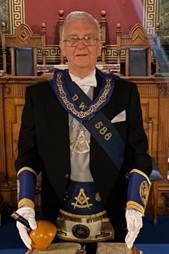
Introduction
Welcome to the Lodge History 150th
Anniversary Souvenir Booklet, a comprehensive compilation that
celebrates the rich heritage and enduring legacy of our esteemed lodge.
This booklet is a tribute to the remarkable journey that our lodge has
embarked upon since its inception, capturing the essence of our shared
experiences, milestones, and the unwavering spirit of camaraderie that
binds us together.
As you turn the pages of this booklet, you
will be transported through time, revisiting the significant events,
notable achievements, and cherished memories that have shaped our
lodge's history. From the founding members'
visionary efforts to the present-day accomplishments, each chapter is a
testament to the dedication, resilience, and unity of our lodge
community.
5 May 2026 - Celebrating
150 Years: A Souvenir of Lodge History
As
we approach the momentous 150th anniversary of our esteemed lodge on May
5th, 2026, we present this souvenir booklet, a testament to our rich and
enduring history. Building upon the foundation laid by our
predecessors in the 2001 centenary publication, this work seeks to
preserve and honour the legacy of our lodge.
The compilation of this booklet is a collaborative
effort, a tribute to the dedicated brethren who have meticulously
gathered and preserved our lodge's history since 1876. To maintain the
authenticity and integrity of their work, we have reproduced much of the
original text verbatim, allowing their voices to resonate through the
years. The period from 2001 to the present day has been carefully
documented, drawing upon the treasures within our history room and the
firsthand accounts of our current members. Furthermore, recognizing the
significance of our physical space, we have included a detailed
description of our temple's architecture, ensuring that its grandeur and
historical importance are preserved for future generations. At this
important juncture it is also important to recognise the people who have
supported us over the years, including our fellow brethren from our
sister lodges and our wife’s and partners, who without their support, we
could not be who we are.
It is our sincere hope that this booklet provides you
with an enlightening and enjoyable journey through the annals of our
lodge.
Falkirk: A Tapestry of History and Industry
Our lodge resides in Falkirk, a town steeped in
history and industrial heritage, nestled strategically between Edinburgh
and Glasgow. This royal burgh, located within the Falkirk council area
of the historic county of Stirlingshire, has played a pivotal role in
Scotland's development. Just a few miles northeast lies Grangemouth, a
crucial hub for Scotland's container port and petrochemical industry,
situated on the River Forth estuary.
Falkirk's strategic location has made it a stage for
significant historical events. The Roman Antonine Wall, a testament to
the empire's northern frontier, traverses the town's southern reaches.
The suburb of Camelon, with its succession of Roman forts, underscores
the region's ancient significance. Notably, Falkirk witnessed two
pivotal battles: the Battle of Falkirk in 1298, where William Wallace's
forces were defeated by King Edward I of England, and the Battle of
Falkirk Muir in 1746, where the Jacobites, under Charles Edward Stuart,
triumphed over the government army led by Lieutenant General Henry
Hawley.
The town's name, Falkirk, is a fascinating linguistic
journey. Originating from the Brittonic "Egglesbreth," meaning "speckled
church," it evolved through the Scottish Gaelic "An Eaglais Bhreac" and
the Scots "Fawkirk" to its current English form. The Latin "Varia
Capella" echoes this meaning. Falkirk Old Parish Church, standing on the
site of a medieval predecessor, may trace its roots back to the 7th
century.
The Antonine Wall, a turf-built counterpart to
Hadrian's Wall, marked the Roman Empire's northern boundary during the
AD 140s. Falkirk has yielded significant Roman artifacts, including a
large coin hoard and a tartan cloth, considered the oldest on record. In
1991, Geoff Bailey confirmed the existence of a Roman fort in the
Pleasance area. Callendar House, with its Roman-themed park, has
received lottery funding to enhance awareness of this historical
landmark.
The 18th century saw Falkirk emerge as a cradle of
Scotland's Industrial Revolution, particularly in iron casting. James
Watt utilized the Carron Iron Works for his early steam engine designs.
The Forth and Clyde Canal (1790) and the Union Canal (1822) facilitated
economic growth, linking Falkirk to Edinburgh and beyond. Early railway
development further solidified the town's industrial prominence. The
Howie family's brickworks and Thomas Laurie & Co Ltd's pioneering street
lighting system exemplify Falkirk's innovative spirit. Today, modern
attractions like the Falkirk Wheel and the Kelpies draw tourists,
showcasing the town's blend of history and modernity.
Architectural Grandeur: Our Temple
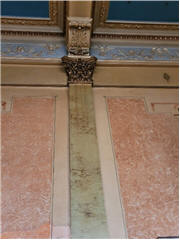
Our temple, a testament to architectural artistry,
shows notes of all five of the noble orders of architecture, the Tuscan,
Doric, Ionic, Corinthian and Composite. Although Tuscan pillars dominate
the west and east of our temple, the most prevalent is the Corinthian
order, the most ornate of the classical Greek and Roman orders. This
order, developed after the Doric and Ionic, is characterized by its
elaborately decorated capitals.
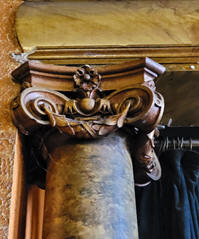
The Corinthian capital, an enriched evolution of the
Ionic, features intricate volutes nestled among stylized acanthus leaves
and stalks. The flat abacus, with its concave curve and rosette
embellishment, adds to the capital's grandeur. As you observe the
pillars within our temple, you can witness these distinctive features.
The Romans, renowned for their architectural
innovation, embraced the Corinthian order, adding the Tuscan and
Composite orders to the classical canon. The Composite order, a fusion
of Ionic and Corinthian elements, reflects the Roman penchant for
adaptation and grandeur. The Corinthian order, with its fluted columns
and ornate capitals, has endured throughout history, inspiring countless
variations.
The name "Corinthian" originates from the ancient
Greek city of Corinth, though its invention is attributed to Athens. Our
temple, embodying this architectural legacy, serves as a tangible link
to the classical world, reminding us of the enduring beauty and
craftsmanship that have shaped our lodge and our community.
|
|
|
The stained-glass windows
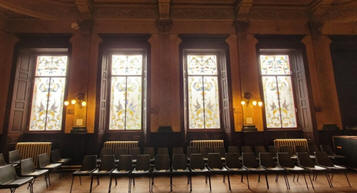
In the north of our Masonic temple stand four
magnificent stained-glass windows, each a radiant tribute to the
principal offices of the Lodge. Bathed in splendour and colour, they
cast a warm glow across the temple, filling the space with an atmosphere
of dignity and reverence. Rather than portraying figures, each window
carries the ancient working tools of our Craft, allowing symbolism to
speak more powerfully than image.
One window represents the Right
Worshipful Master, its centrepiece a golden square, radiating against a
backdrop of sapphire and crimson. The brilliance of the square reminds
us of truth, integrity, and the guiding authority of the Chair. Another,
dedicated to the Worshipful Senior Warden, bears the level in rich tones
of deep green and royal purple, its balance and symmetry reminding us of
equality, duty, and strength. A third window, honouring the Worshipful
Junior Warden, features the plumb, set within a burst of orange and
indigo glass, symbolising uprightness and moral rectitude. Finally, the
fourth window celebrates the unity of the Brethren through the trowel,
rendered in vivid emerald and ruby hues, its purpose to spread the
cement of brotherly love and affection.
Together, these windows shine with
splendour and colourfulness, their artistry enriching the temple with
beauty and meaning. They stand in the north as a constant reminder of
the enduring values and solemn offices of the Lodge, inspiring all who
gather within.
Our Right Worshipful Master and
office bearers
| Right Worshipful Master | Bro. Alan M Buchanan |
| Depute Master | Bro. David B Blair |
| Immediate Past Master | Bro.Calum J. McArdle IPM |
| Substitute Master | Bro. Ian Hunter |
| Senior Warden | Bro. Jamie Finlay PM |
| Junior Warden | Bro. Kenny Darnton |
| Secretary | Bro. John R. Galloway |
| Treasurer | Bro. Colin J. Chalmers PM |
| Almoner | Bro. Andrew Ferguson |
| Dir. of Ceremonies | Bro. Jim Craigie PM |
| Chaplain | Bro. James H Chalmers |
| Senior Deacon | Bro. Calum J. McArdle IPM |
| Junior Deacon | Bro. Grant Mitchell |
| Architect | Bro. Nadeem Qurban |
| Jeweller | Bro. Alex McArdle |
| Bible Bearer | Vacant |
| Bard | Bro. Kieran Forsyth |
| Standard Bearer | Bro. Reece Ryan |
| Director Of Music | Vacant |
| Inner Guard | Bro. Craig H. Martin |
| Senior Steward | Vacant |
| Junior Steward | Vacant |
| Tyler | Bro. Barry I. Hamilton PM |
Past Masters of Lodge Callendar No 588
| Bro Archibald Galloway | 1876 – 1879 |
| Bro Alexander Kirkwood | 1879 – 1881 |
| Bro Charles Malcolm | 1881 – 1886 |
| Bro John Gardiner | 1886 – 1887 |
| Bro Harry Smith | 1887 – 1888 |
| Bro John Gray | 1888 – 1889 |
| Bro Peter Baird | 1889 – 1890 |
| Bro George J. Murray | 1890 – 1892 |
| Bro William Simpson | 1892 – 1895 |
| Bro W.W. Barr | 1895 – 1898 |
| Bro Samuel Porter | 1898 – 1901 |
| Bro William Murphy | 1901 – 1904 |
| Bro J.G. Russell | 1904 – 1906 |
| Bro Robert Mather | 1906 – 1908 |
| Bro William Smith | 1908 – 1910 |
| Bro Thomas M. Copland | 1910 – 1912 |
| Bro William MacNiven | 1912 – 1914 |
| Bro John Christie | 1914 – 1916 |
| Bro John Wilson | 1916 – 1919 |
| Bro James Wright | 1919 – 1921 |
| Bro Alex Garden | 1921 – 1923 |
| Bro Thomas Pitcairn | 1923 – 1925 |
| Bro William H. Smith | 1925 – 1927 |
| Bro George Christie | 1927 – 1929 |
| Bro Charles Smith | 1929 – 1931 |
| Bro Edward N. Hunter | 1931 – 1933 |
| Bro Henry B. Fowler | 1933 – 1935 |
| Bro James Cowan | 1935 – 1937 |
| Bro James F. Shand | 1937 – 1939 |
| Bro James Wright | 1939 – 1942 |
| Bro Matthew B. Blackadder | 1942 – 1944 |
| Bro William Adam | 1944 – 1946 |
| Bro Alex Walker | 1946 – 1948 |
| Bro Alex Shand | 1948 – 1950 |
| Bro Robert Lamb | 1950 – 1952 |
| Bro Robert W. Lyon | 1952 – 1954 |
| Bro Richard H. Parker | 1954 – 1956 |
| Bro J.H. Waddell | 1956 – 1958 |
| Bro G.W. Anderson | 1958 – 1960 |
| Bro Andrew Erskine | 1960 – 1962 |
| Bro Adam H. Lyon | 1962 – 1964 |
| Bro James B. Paterson | 1964 – 1966 |
| Bro William R. Marshall | 1966 – 1967 |
| Bro William C.B. Lyon | 1967 – 1969 |
| Bro William Fleming | 1969 – 1971 |
| Bro Peter Crawford | 1971 – 1973 |
| Bro J Sharp | 1973 – 1975 |
| Bro David D. Laing | 1975 – 1977 |
| Bro James Weir | 1977 – 1978 |
| Bro David R. Dobbie | 1978 – 1980 |
| Bro George Young | 1980 – 1982 |
| Bro Andrew A. McKinnon | 1982 – 1984 |
| Bro David P. Cox | 1984 – 1986 |
| Bro John R. Whittit | 1986 – 1988 |
| Bro James West of Stow | 1988 – 1990 |
| Bro Robert P. Watt | 1990 – 1992 |
| Bro William S Davidson | 1992 – 1994 |
| Bro John Gillies | 1994 – 1996 |
| Bro J. Philip Crozier | 1996 – 1998 |
| Bro John H. Shand | 1998 – 2000 |
| Bro James D. Craigie | 2000 – 2002 |
| Bro Robert Mason | 2002 – 2004 |
| Bro James Watt | 2004 – 2006 |
| Bro Jamie S. Finlay | 2006 – 2008 |
| Bro Alistair J. Crawford | 2008 – 2010 |
| Bro John B. Crozier | 2010 – 2012 |
| Bro Stuart Hunter | 2012 – 2014 |
| Bro William S Davidson | 2014 – 2016 |
| Bro James Weir MBE | 2016 – 2018 |
| Bro Barry I. Hamilton | 2018 – 2019 |
| Bro. Colin J. Chalmers | 2019 – 2022 |
| Bro. Calum J. McArdle | 2022 – 2024 |
| Bro. Alan M Buchanan | 2024 – |
The first one hundred years 1876 –
1976
The following is a copy of the Working Letter of
Authority which was sent down, investing the office-bearers with full
powers for the working and conduct of the Lodge until such time as the
Charter could be prepared:
GRAND LODGE OF SCOTLAND
No. 588
"WHEREAS upon the 5th day of May, 1876 a PETITION in
regular order and properly recommended was presented to the Grand
Committee, praying for the Erection of a Lodge at Falkirk under the Name
and Title of "The Callendar," Falkirk, which Petition was favourably
entertained by Grand Committee and Grand Lodge recommended to grant the
Charter prayed for, which recommendation Grand Lodge was pleased to
adopt; In order, therefore, to save time, until the Charter is expede,
interim authority is granted by said Grand Committee to Archibald
Galloway, John Kirkwood, James Stewart Wood, Alexander Kirkwood, John
Happer, James McMillan, Robert Stirling, John Cullen, Robert Brownlee @
c., the PROPOSED OFFICE-BEARERS of the NEW LODGE, to hold regular
Meetings thereof, Enter Apprentices, Pass Fellow-crafts, and Raise to
the Sublime Degree of Master Mason: and generally to do in the premises
all that pertains to the conduct of a well-ordered and well-regulated
Lodge: for all which this Working Letter of Authority to the said R.W.M.
and other Office-Bearers Elect shall be a full and sufficient warrant.
Given at FREEMASONS' HALL in the City of Edinburgh
this 6th of June, 1876. J. LAURIE, Grand Secretary
The Story of Lodge Callendar No. 588
The story of Lodge Callendar No. 588 begins with a
group of visionary men, Mr. John Happer, Mr. Archibald Galloway, Mr.
John Kirkwood, Mr. Alexander Kirkwood, Mr. R. Brownlee, Mr. J. Cullen,
Mr. G. Roper, Mr. J. Wood, and Mr. R. Stirling, all members of Lodge St.
Andrew No. 199, Cumbernauld. United by a shared purpose and a deep
commitment to Freemasonry, they resolved to establish a new Lodge in
Falkirk.
Among them, Mr. R. Stirling, a respected solicitor in
Falkirk, took on the role of secretary, managing the early
correspondence and formalities. Their efforts were soon rewarded when
Mr. William Forbes of Callendar graciously granted permission for the
Lodge to bear the Callendar name and adopt its distinguished blue and
gold colours.
By early May 1876, the group submitted a formal
application to the Grand Lodge of Scotland, and on May 5th, Lodge
Callendar No. 588 was officially chartered. The first meetings were held
in Bank Street Church Hall, with Bro. Archibald Galloway installed as
the Lodge’s first Right Worshipful Master. The inaugural initiation took
place on June 1st, 1876, welcoming seven candidates. By the end of that
year, 32 initiates had joined, a promising beginning.
As membership steadily grew, the Lodge moved in 1888
to the Masonic Hall in Newmarket Street, having surpassed 200 members.
Though the early years saw fluctuations in candidate numbers, the Lodge
continued to thrive. By the 1890s, the founding brethren began to pass
on, and in 1900, Life Membership was introduced to honour long-standing
commitment.
A golden era followed under Bro. William Murphy, who
served as R.W.M. from 1901 to 1904. During his tenure, the Lodge saw a
remarkable 159 initiations in just three years. In 1902, Bro. Bailie
Russell proposed securing a permanent home for the Lodge. A successful
bazaar raised over £1,600, and by 1906, a site was secured. On November
3rd, the Memorial Stone was laid, and the new Temple at Lint Riggs was
consecrated by Bro. William Black, Provincial Grand Master. The first
meeting in the new Temple was held on September 4th, 1907.
Lodge Callendar quickly became a pillar of the
community, actively supporting public causes such as the Redding Pit
Disaster Fund and the Falkirk Infirmary Appeal. In 1912, Bro. Robert
Dollar of San Francisco was granted Honorary Membership, and by 1913,
the Lodge had successfully refinanced its debt.
During World War I, the Lodge suspended fees for
members in service and contributed to war relief efforts. A Roll of
Honour, hand-drawn and illuminated, now hangs in the east of the Lodge,
a solemn tribute to those who served. Among the names inscribed:
-
2nd Lieut. James Scott Smith, Royal Scots
-
Able Seaman George S. Warner, Royal Navy
-
Pte. John Fraser, Army Service Corps
-
Pte. Donald Campbell, Army Service Corps
-
Sapper John D. B. Rae, Canadian Engineers
-
Sergt. A. McGregor, B.R.C.S.
-
Pte. Charles McPherson
-
Pte. John McGilchrist, Cameron Highlanders
-
Pte. George H. Walker, Scots Guards
-
Pte. John R. Baillie, Royal Scots
-
Pte. John Baird, Royal Scots
May their sacrifice never be forgotten.
The Lodge celebrated its Golden Jubilee in May 1926
with a banquet, a dance, and a special church service. Honorary Life
Memberships were awarded to Bro. Robert Dollar and Bro. Andrew Hunter in
recognition of their outstanding contributions.
1926–1976:
Growth, Service, and Resilience
Despite the challenges of the Great Depression, Lodge
Callendar continued to flourish.
In the 1930s, the Lodge honoured its members with
jewels and honorary memberships, while also managing financial concerns
with prudence. In 1940, the Temple at Lint Riggs was requisitioned for
military use, prompting a temporary move to the Old Parish Church Hall,
and later, the Gas Showrooms.
During World War II, Lodge Callendar contributed to
the Grand Lodge War Distress Fund and supported members in service. In
1941, Bro. John Jack received the British Empire Medal from King George
VI for secret national service. In 1943, Bro. James Ferguson was named
Honorary Grand Bible Bearer after 34 years as Treasurer.
The war interrupted many Masonic journeys. Bro. Alex
Marshall was raised to Master Mason in Washington Lodge No. 21, New
York, and Bro. William Roberts completed his term as Provincial Grand
Master of Sutherland. The Lodge returned to Lint Riggs in 1946, and in
1949, Bro. Tom Pitcairn became Provincial Grand Master of Stirlingshire.
The 1950s and 60s brought continued recognition. New
regalia was purchased, and Distinguished Service Diplomas were awarded.
Bro. Pitcairn later served as Substitute Grand Master of Scotland
(1954–1956). The Lodge mourned the passing of Bro. Ferguson in 1954, who
had served as Treasurer for 47 years.
In 1967, the Lodge lost R.W.M. Bro. W. Marshall,
whose widow donated a chain of office in his memory. Honorary
memberships and generous donations followed, and by 1970, long-serving
members were honoured, including Bro. Richard Parker. The Lodge
contributed to the Ibrox Disaster Appeal Fund and received a rare book
on installation ceremonies.
In 1972, the Most Worshipful Grand Master Mason of
Scotland attended a solemn Third Degree ceremony. That year, five
members received 50-year Jubilee Diplomas, and a Grand Sale of Work
raised £900 for new chairs and Lodge funds. The Lodge suffered the loss
of Treasurer Bro. Archibald Shirra and Immediate Past Master Bro. Peter
Crawford in 1975.
As the Centenary
approached, a committee formed in 1973 worked diligently to prepare. By
1975, fundraising had reached £1,200, covering new regalia, goblets,
ties, and medallions. Bro. David D. Laing, installed as Master in 1975,
presided over the Centenary celebrations, marking 100 years of Lodge
Callendar’s proud and enduring service to Freemasonry.
|
|
|
|
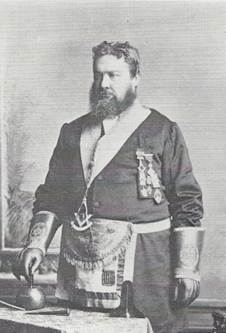
BRO. ALEX GALLOWAY R.W.M. |
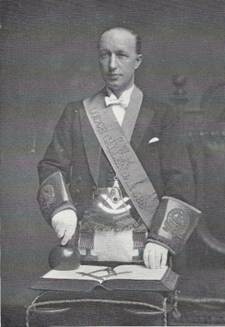
BRO. WILLIAM H. SMITH |
|
|
|
|
BRO. DAVID D. LAING |
|
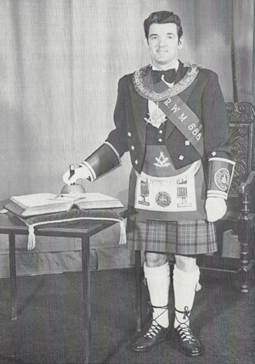
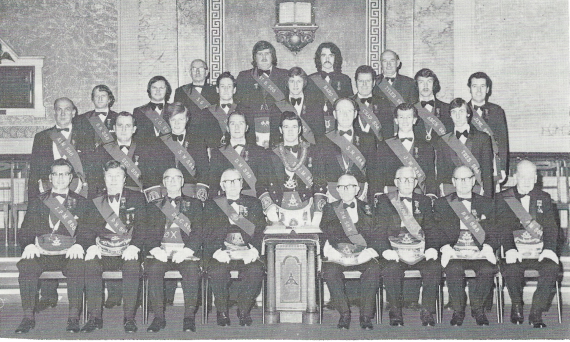
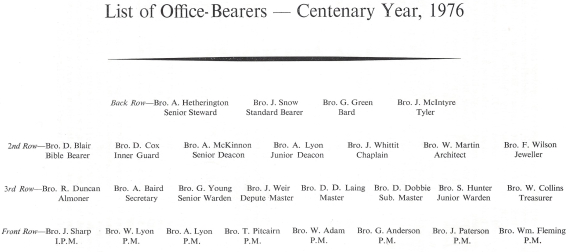
Re-Dedication Service was held in the Masonic Temple,
Lint Riggs, on Thursday the 6th of May, 1976. The service
was conducted by the Most Worshipful Grand Master Mason, Bro. Captain R.
Wolrige Gordon of Esslemont and Office-Bearers of Grand Lodge.
A Centenary Dinner was held in Falkirk Ice Rink, at 8
p.m. on the same evening, with some 250 Brethren present. Many
Distinguished Masons from Stirlingshire and Sister Provinces in
attendance.
A service of Thanksgiving was held in Falkirk Old
Parish Church on Sunday the 9th of May, at 3.00 p.m. It was
conducted by Bro. Rev. George Gillan, M.A., C.F., J.P. A dance was held
in the Cladhan Hotel, Falkirk, on Friday, 14th May.
In that year the following
presentations were recorded as held by the lodge, many of which are
still in use today.
|
1877 |
Altar |
Bro. T. S. Thomson 333 |
|
1878 |
Carpet |
Bro. T. B. McFadzen 16. |
|
Emblems |
Bro. Findlay, R.W.M. 333. |
|
|
Ballot Box |
Bro. H. Donaldson. |
|
|
1879 |
Wardens' Batons |
Bro. W. Mitchell 16. |
|
1880 |
Present Master's Mallet |
Bro. W. Mitchell 16. |
|
1900 |
Square and Compasses |
Bro. W. Mann. |
|
1905 |
Working Tools |
Bro. R. Fleming. |
|
Jewels |
Bro. A. Grierson. |
|
|
1906 |
Volume of Sacred Law, and Cushion Rest |
Bro. W. W. Callander, Secy. |
|
1907 |
Emblems and Chest |
Bro. D. Fowler S.B. |
|
Oak Desk for Attendance Book |
Bro. W. W. Callander, Treas. |
|
|
1908 |
Globes for Pillars |
Bro. J. O'May. |
|
Album for P.M.'s Photographs |
Bro. W. Murphy. |
|
|
1910 |
Framed Scroll of Marks, etc |
Bro. M. Buchanan. |
|
1913 |
Parchment Certificate (Bro. R. Dollar) |
Bro. J. G. Russell. |
|
1922 |
Photograph of Temple |
Bro. J. G. Russell. |
|
1923 |
Deacons' Rods |
Bro. H. Fowler. |
|
D. of C. Baton, and 24' Gauge |
Bro. D. Fowler. |
|
|
1925 |
Mallet |
Bro. A. Hunter, P.M. 16. |
|
1926 |
Oak Stand for Charter |
Bro. D. Fowler. |
|
1950 |
Wardens' Columns |
Bro H. Johnstone. |
|
1962 |
Chaplain's Bible |
Bro. Thos. Pitcairn, P.M. |
|
1967 |
Master's Chain of Office, and Jewel |
Mrs. W. Marshall. |
|
Frame for P.M.'s Photographs. |
Bro. D. D. Laing. |
|
|
Installation Altar (for Master) |
Bro. D. D. Laing. |
|
|
1968 |
Collection Plates |
Bro. R. Paterson, H.M. 588. |
|
D. of C. Baton |
Bro. H. Freckleton, H.M. 588. |
|
|
1972 |
Donation from Estate of £250 |
Bro. R. Galbraith, S.M. 588. |
|
1973 |
Bible Markers |
Bro. Peter Crawford, P.M. |
|
1976 |
Set of Working Tools - 1st, 2nd, 3rd
Degree |
Ladies' Committee, 588. |
A Town and a Lodge in Transition, 1976–2001
The closing decades of the twentieth century brought
sweeping change to Falkirk, reshaping both its skyline and its spirit.
Between 1976 and 2001, the town underwent a transformation that touched
nearly every corner of its centre and surrounding districts.
What had once been a market town defined by
traditional industries became a landscape of redevelopment and modern
ambition. The High Street was pedestrianised, altering traffic flow and
restricting vehicle access to Lodge Callendar. Familiar buildings
vanished under the hand of demolition, replaced with contemporary
structures that, at the time, symbolised progress. The old Aitken’s
Brewery offices, once the beating heart of a local industry, were reborn
as licensed premises and a restaurant. Across in Camelon, the Pleasance
district was redeveloped, and the ageing swimming baths disappeared in
favour of new facilities.
The railway depot at Grahamston, a relic of Falkirk’s
industrial age, was transformed into a retail park crowned with a cinema
complex, while the Callendar Square Shopping Centre rose from the
footprint of the beloved Silver Row Roxy Theatre.
But the most remarkable change was the rebirth of the
Forth and Clyde Canal. Dormant for half a century, its waters stirred
again as part of a bold plan to make it navigable once more. The jewel
of this project was the Falkirk Wheel, a marvel of modern engineering
that reconnected the Union and Forth and Clyde canals, links severed
since the demolition of the Port Downie lock gates decades earlier. This
singular structure not only revitalised the canal but also placed
Falkirk on the map as a centre of innovation.
Towards the turn of the century, Falkirk Football
Club prepared to leave its spiritual home at Brockville Park for a new
stadium at Westfield, near the Middlefield Warehouse complex. Meanwhile,
education was reshaped with the demolition and rebuilding of Graeme High
and Falkirk High Schools, ensuring the next generation studied in modern
facilities.
Through all this transformation, the Masonic lodges
of Falkirk, and Lodge Callendar in particular, stood as bastions of
continuity guardians of tradition amid the changing face of the town.
The Life of the Lodge
The story of Lodge Callendar during these years was
one of resilience, fellowship, and quiet service. Members weathered
losses, celebrated triumphs, and nurtured bonds across Scotland and
beyond, ensuring that the Lodge remained as relevant in a changing world
as it had been in earlier centuries.
In December 1977, Brother James Weir was installed as
Right Worshipful Master. Illness forced him to step down after only a
year, yet his recovery and later role as a piper in the Bowmore Pipe
Band spoke to the perseverance that characterises the Craft. Over the
following two decades, twelve brethren would serve as Master, each
leading the Lodge for two years before taking up the mantle of Immediate
Past Master.
The Lodge knew moments of deep sadness. In January
1978, the brethren mourned the passing of Brother Alexander Barrie,
initiated in 1923 and a recipient of his 50-year diploma, and Brother
Kenneth Smith, initiated in 1947, who had given 18 years of faithful
service to the Enquiry Committee. Later that year, the Lodge was
enriched by visits from neighbouring lodges. Lodge St. Andrew Denny and
Loanhead, No. 176, conferred the Entered Apprentice Degree on five
candidates, and a deputation from Lodge St. John, Haddington, and Lodge
Carron attended in November. On that occasion, Brother Archibald D.
Wallace, Past Master of Lodge St. John, was granted honorary membership.
December 1978 brought pomp and ceremony as Brother
David R. Dobbie was installed as Master, the ceremony conducted by
Brothers Peter Leckie and Alexander Stewart, with the Provincial Grand
Lodge represented by R.W.P.G.M. Angus Campbell.
The 1980s were years of both celebration and
remembrance. In 1980, Brother George Young was installed as Master.
Three years later, the Lodge honoured Brother Alexander Gibson, then
aged 96, with his 50-year diploma, a remarkable testament to lifelong
commitment. That same year, Brother Richard M. Coll became Hall Keeper,
a role he held until 1990, remembered by all for the warmth and courtesy
he and his wife extended to visitors.
During his second term as Master in 1986, Brother
David R. Cox proudly represented Lodge Callendar at the 250th
Anniversary of the Grand Lodge of Scotland. The following year, R.W.M.
John R. Whittit marked Brother William C. B. Lyon’s 40 years of
membership with a commemorative leather case, a fitting tribute to his
devotion.
The 1990s saw fraternal bonds deepen. Delegations
visited from near and far, honorary memberships were bestowed, and new
bye-laws were adopted to govern the Lodge. Yet, perhaps the most
poignant moment came in March 1996, in the shadow of the Dunblane
tragedy. Under the leadership of R.W.M. John Gillies, the Lodge stood in
solemn silence and raised £200 for the Dunblane Appeal Fund, part of a
nationwide expression of grief and solidarity. The Grand Lodge of
Scotland later installed stained glass windows in local churches,
memorials to the children whose lives were lost.
In the same year, international friendship flourished
when Lodge Callendar welcomed visitors from Mourne Masonic Lodge No. 696
in Annalong, Northern Ireland. That bond grew stronger in 1997, when
twenty-five brethren from Falkirk travelled to Mourne Lodge to
demonstrate a Third Degree. So enduring was this relationship that
Brother John P. Crozier, R.W.M. of Lodge Callendar, was proposed for
membership in Mourne Lodge, cementing the ties between Scotland and
Ulster.
As the millennium approached, the Lodge turned its
attention to honouring its elders. In 1998, Brothers William C. B. Lyon
and David Silcock were each presented with their 50-year diplomas. The
following year, a lecture on the Working Tools by Brother William C.
Law, Past Master of Lodge 780, deepened the Lodge’s appreciation for the
symbolism and moral lessons of the Craft.
The year 2000 marked one of the most significant
moments in the Lodge’s history. On May 20, Lodge Callendar hosted the
installation of the new Provincial Grand Master of Stirlingshire,
Brother David D. Laing, Past Master of Lodge 588. The ceremony was
conducted by the Most Worshipful Grand Master Mason, Brother Archibald
D. Orr Ewing, in front of a packed temple that included representatives
from ten sister Provinces. Dignity, solemnity, and tradition filled the
hall, making it a day long remembered.
That same year, Brother James D. Craigie presided
over Lodge Callendar’s 125th Anniversary celebrations, linking the
Lodge’s Victorian founding with its modern presence. It was a fitting
reminder that, though Falkirk itself had changed almost beyond
recognition, the Lodge remained a steadfast thread in the town’s fabric.
By 2001, Falkirk had entered a new era, with modern
shopping centres, new schools, a new stadium, and an international
landmark in the Falkirk Wheel. Yet amidst this transformation, Lodge
Callendar endured as it always had: a place of fraternity, education,
and service, both a witness to change and a custodian of tradition.
THE 125th ANNIVERSARY CELEBRATIONS
The 125th Anniversary Celebrations took place at our
Temple on Friday, 28th September 2001. The Provincial Grand Lodge of
Stirlingshire conducted the Ceremony of Rededication, with the Right
Worshipful Provincial Grand Master, Bro. David D. Laing, presiding. Bro.
The Reverend John H. Jenkinson, L.T.C.L. A.I.C.M. Dip. Ed. V. W. Senior
Grand Chaplain of the Grand Lodge of Scotland and Senior Grand Chaplain
of the Provincial Grand Lodge of Stirlingshire, was escorted around the
Lodge by Bro. Alexander Montgomery, Provincial Grand Director of
Ceremonies.
The Right Worshipful Master of the Lodge, Bro. James
D. Craigie, delivered the Obligation on behalf of Lodge Callendar and
its Brethren, both present and future. The ceremony concluded with the
Benediction by the Chaplain, imparting a dignified and solemn
atmosphere, and a meaningful message about our responsibilities to our
Masonic Craft, our Lodge, and society.
Following the ceremonial celebrations, a dinner was held, with the relevant Toast List being pledged. The event concluded with the singing of "Auld Lang Syne," marking another successful chapter in our Lodge's history.
The office bearers and members of the lodge during the 125th Anniversary celebrations.
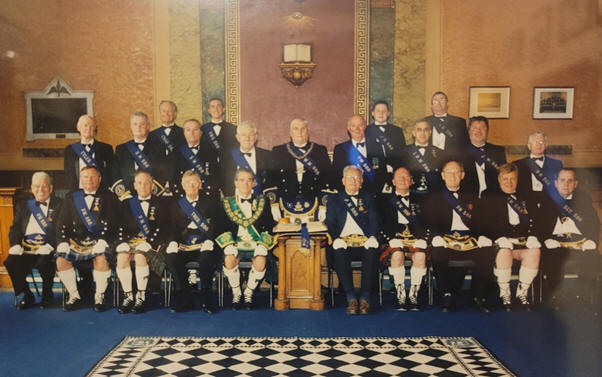
|
3rd Row L to R |
Bro. David Downie, Chaplin,
Bro Ross Young, Bro Jamie Finlay, Junior Steward, Bro.
Alexander Croy, Inner Guard |
|
2nd Row L to R |
Bro. Robert Kemp, Tyler, Bro Robert Mason, W.S.W, Bro William S. Davidson, P.M, Bro John Gillies, P.M, Bro James D Craigie, R.W.M, Bro. John P. Crozier, P.M, Bro. John H. Shand, P.M, Bro. James Watt, W.J.W, Bro. David B. Blair, Bible Bearer |
|
1st Row L to R |
Bro. John R. Whittit, P.M, Bro. David R Cox, P.M, Bro. Andrew A McKinnon, P.M, Bro. William C.B Lyon, P.M, Treasurer, Bro. David D Laing , P.M, DoC, Bro. Joseph Sharp, P.M, Bro. James Weir, P.M, Bro. David R. Robbie, P.M, Bro. George Young, P.M, Bro. Alexander Baird, Secretary |
2001- 2026
Falkirk- The last 25 years
Between 2001 and May 2026, Falkirk
underwent extensive cultural, infrastructural, and economic development,
marked by several major projects that strengthened its profile within
Scotland. A defining milestone occurred in 2001 with the opening of the
Falkirk Wheel, the world’s only rotating boat lift. Designed to
reconnect the Union Canal with the Forth & Clyde Canal as part of the
Millennium Link project, the Wheel became an immediate engineering
landmark and a major catalyst for increased tourism and regeneration in
the district. Its success set the tone for Falkirk’s long‑term
development strategy, centred on heritage, innovation, and public space
enhancement.
Throughout the
mid‑2000s, the town centre saw phased improvements aimed at modernising
commercial and civic areas. Key transport upgrades, including
improvements to the M9 junctions serving Falkirk, enhanced regional
connectivity and supported economic activity. Local shopping hubs such
as the Howgate Centre also underwent refurbishment during this period,
reflecting wider national trends in adapting high‑street retail
environments.
A transformational period followed
in the early 2010s. In 2013, extensive redevelopment of the Howgate
Centre was completed, improving public spaces and retail units. Around
the same time, Falkirk F.C. advanced several facility improvements,
including development at their training base at Little Kerse,
strengthening the club’s community and youth football infrastructure.
Perhaps the most iconic development
of the modern era occurred in 2014 with the unveiling of The Kelpies,
the 30‑metre‑tall stainless‑steel horse‑head sculptures created by
Scottish artist Andy Scott. These monumental structures became the
centrepiece of The Helix, a major parkland and community project
developed through partnerships between Falkirk Council, Scottish Canals,
and national funding bodies. The Kelpies, instantly recognisable and
heavily visited, propelled Falkirk into global travel media and
established the area as a key Scottish tourism destination.
Across the late 2010s and early
2020s, work continued to expand walking and cycling networks, improve
canal‑side amenities, and develop cultural programming at the Helix and
Callendar Park. Falkirk also participated in national environmental
initiatives focused on sustainable transport and green‑space
development.
The COVID‑19 pandemic (2020–2021)
affected local businesses, events, and tourism, but Falkirk adapted
through phased reopening plans, expanded outdoor infrastructure, and
support for local enterprise recovery. By 2022, visitor numbers to the
Helix, Kelpies, and Falkirk Wheel had rebounded significantly.
In the mid‑2020s, Falkirk
continued to position itself as a hub for heritage tourism, events, and
outdoor recreation. Preparations for civic and cultural programmes
scheduled for May 2026 included community events, historical
exhibitions, and initiatives linked to Scotland‑wide tourism campaigns.
By this time, Falkirk’s two major landmarks, the Kelpies and the Falkirk
Wheel, had firmly established the region as one of Scotland’s most
distinctive visitor destinations, while infrastructural investments and
parkland developments continued to benefit residents and visitors alike.
Our Candidates
As we approach the 150th anniversary of our Lodge, it is a fitting time
to reflect on the number of candidates who have passed through our
doors.
|
Period |
Candidates Admitted |
|
1976–1987 |
132 |
|
1988–1998 |
123 |
|
1999–2010 |
66 |
|
2011–2025 |
69 |
In the first century of our Lodge’s history, admissions to the Craft
were strong, with annual averages ranging between 100 and 200
candidates. However, since then, we have seen a steady decline in the
number of men joining our Lodge. Over the past two decades, admissions
have dropped to nearly half of what they were in the 1970s and 1980s.
This decline is not unique to us; it is a trend seen across the wider
fraternity. Yet it is being felt acutely within our own Lodge. While
welcoming new candidates is vital, it is only part of the picture. We
are also experiencing a noticeable drop in the number of brethren
regularly attending meetings.
There may be many reasons for this: the evolution of society, changing
priorities, or simply the fast pace of life in this more modern age. It
is worth noting that our Lodge has faced similar challenges before. In
the late 1880s through to the early 1900s, candidate numbers were also
low. Highs and lows are part of any organisation’s journey.
The values of family, fellowship, and personal growth remain central to
our Order. As members, we each share a responsibility to ensure that our
Lodge not only endures but thrives well beyond our 150th anniversary.
The ladies of our lodge
The importance of wives and partners in supporting a Masonic lodge
cannot be overstated. While the Brethren form the visible face of our
ceremonies and labours, it is so often the quiet strength and tireless
encouragement of wives and partners that sustains the life of the Lodge.
Their contribution extends well beyond companionship; it is woven into
the very fabric of our success, ensuring that our temple remains not
only a place of tradition and ritual, but also of warmth, fellowship,
and community.
One of the most significant ways in which wives and partners support the
Lodge is through their involvement in social and fundraising activities.
Across the years, they have organised raffles, coffee mornings, dinners,
and dances, bringing not only financial benefit but also a sense of
togetherness. These events provide opportunities for families and
friends to come together, fostering bonds that reach beyond the formal
boundaries of the Lodge. They allow Freemasonry to be seen in its truest
light: a community rooted in charity, fellowship, and shared values.
The results of their efforts are clear to see within our own temple.
Through fundraising initiatives led and supported by wives and partners,
we have been able to purchase many of the elements that now enhance the
dignity and comfort of our Lodge. From the refurbishment of furnishings
and seating to the acquisition of ceremonial items and decorative
features, their work has enriched our surroundings and ensured that the
Lodge is well equipped for present and future generations. The 1st
, 2nd and 3rd degree working tools that we use in
every one of our ceremonies was purchased from proceeds raised by the
ladies committee in 1976. Each item within the temple, whether practical
or symbolic, carries with it the unseen hand of those who gave their
time and energy to make it possible.
Beyond material contributions, the moral support given by wives and
partners is equally invaluable. Their understanding of the time and
commitment required by Freemasonry enables members to participate fully
in the work of the Lodge. Their encouragement strengthens our resolve
and allows us to give of ourselves in charity, ritual, and service. In
many respects, they are silent partners in the Craft, sharing in its
burdens and its joys, though without formal recognition.
It is also important to note that through their presence at social
functions, wives and partners act as ambassadors for Freemasonry. By
welcoming guests, engaging with the wider community, and helping to
showcase the charitable heart of our Order, they reinforce the positive
image of the Lodge and extend its reach beyond our walls. Their grace
and hospitality are vital elements in creating an atmosphere where
friendship flourishes and misconceptions about the Craft can be
dispelled.
Wives and partners stand at the heart of our Lodge’s vitality. Their
fundraising has provided us with tangible benefits that beautify and
sustain our temple, while their unwavering moral support enables the
Brethren to dedicate themselves to Masonic work with confidence and
peace of mind. They embody the principles of love, charity, and service
that lie at the core of Freemasonry, and for this we owe them our
deepest gratitude.
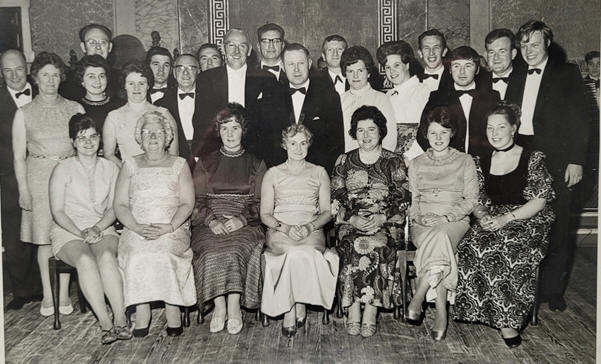
The photograph below is a snapshot in time taken from a dance held in
our temple around the time of the centenary celebrations.
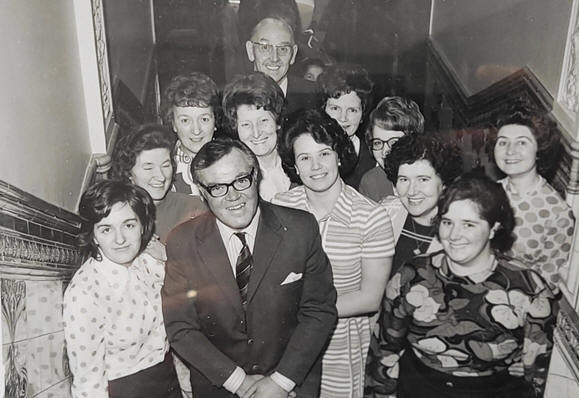
The next photograph shows some of the people responsible for raising funds for our lodge that has helped to pay for the working tools that are still in use today.
Deputations and Visitors to Our Lodge
As part of our regular business
over the years, we have been honoured to welcome a wide range of
distinguished deputations to our Lodge. These have included visits from
sister Lodges within the Province, as well as deputations from the
Provincial Grand Lodge of Stirlingshire and the Grand Lodge of Scotland.
On every occasion, our members have ensured that visitors receive a warm
and cordial welcome, reflecting our Lodge’s standing within the
Province.
Below are a few extracts from our
minute books highlighting some of these memorable visits:
20th September 2004 – Fellow Craft Degree – R.W.M. Bro. Robert Mason
A deputation from Lodge Caldercruix No. 1314, headed by Bro. Jeff
Spence, was admitted and warmly welcomed by the R.W.M. The deputation
was invited to confer the Fellow Craft Degree on one candidate, namely
Jamie Wilson.
23rd January 2006 – Fellow Craft Degree – R.W.M. Bro. James Watt
A large deputation from Lodge St. Andrew Denny and Loanhead No. 176,
headed by R.W.M. Bro. Ian Campbell, was admitted into the Lodge.
Following due preparation, the following brethren were passed to the
Fellow Craft Degree: Derek Sheppard, Bruce Tulloch, and Steven Angus
Adam.
8th Febr1uary 2008 – Fellow Craft Degree – R.W.M. Bro. Jamie Findlay
A deputation of thirty Office Bearers and Brethren from Lodge Polmont
No. 793, headed by R.W.M. Bro. Alan Campbell, was welcomed into the
Lodge to confer the Second Degree on candidate Alan Thomas Liddle.
Past Masters’ Degrees
Over the years, our Past Masters have had the honour of conducting degrees; occasions that are always special and memorable. These events not only provide a meaningful experience for candidates and brethren alike but also showcase the depth of knowledge and tradition that exists within our Lodge. They are a testament to the enduring values and integrity of our institution. Although these are an annual event in our lodge, a single example has been taken from our archives.
10th April 2006 – Past Masters’ Third Degree – R.W.M. Bro. James Watt
A deputation of Past Masters of Lodge Callendar, headed by P.M. Bro.
James Craigie, was admitted and warmly welcomed by R.W.M. Bro. James
Watt. The R.W.M. then presented the emblem of authority to P.M. Bro.
Craigie, who, along with his team of Past Masters, proceeded, after due
preparation, to raise the following brethren to the high and sublime
degree of Master Mason: Robert Paterson and William Paget.
Degree Team on the Night:
-
R.W.M.: Bro. James Craigie
-
Senior Warden: Bro. David Laing
-
Director of Ceremonies: Bro. William Davidson
-
Junior Deacon: Bro. Robert Mason
-
Junior Warden: Bro. Andrew McKinnon
-
Senior Deacon: Bro. Philip Crozier
-
Chaplain: Bro. John Whittit
-
Retrospect: Bro. John Shand
This visitation, at the time of writing, was the last one of our 150 years where the team conducted a 3rd degree on a progressive candidate. As always the degree team performed to the highest of standards. The picture below shows all those who were involved on the night.
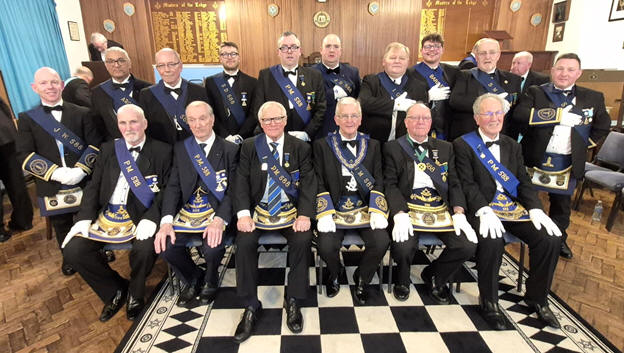
Second Row:
Bro. Kenny Darnton W.J.W, Bro. Nadeem Qurban, Arch,
Bro. Andrew Ferguson, Almoner,
Bro. Calum McCardle P.M, S.D , Bro. Colin Chalmers P.M, Tres, Bro. Grant
Mitchell J.D, Craig H. Martin I.G, Keiran Doyle, Bard, Bro. Ian Hunter
S.M, Bro. Jamie Findlay P.M, W.S.W
Front Row:
Bro. James Craigie P.M M.O.C, Bro. William Davidson P.M,
Bro. David Cox P.M, Bro. Alan
Buchanan R.W.M, Bro. James Weir P.M, Bro. Stuart Hunter P.M,
Bro. Ian Hunter, SM, Bro. Jamie Findlay P.M, WSW
Burns Suppers
Lodge Callendar 588, recognising the enduring
influence of Burns, holds an annual Burns Supper to celebrate his life,
his works, and his contribution to Scottish identity. The evening is
steeped in tradition, combining the ceremonial presentation of haggis
with recitations of Burns’ poetry, songs, and reflections on his life.
The event showcases the skill and dedication of the lodge’s members,
particularly those who take on the role of the poets for the evening.
Their careful preparation and eloquence ensure that each recitation
captures the rhythm, wit, and passion of Burns’ verse, bringing his
words vividly to life for all in attendance.
The Burns Supper at Callendar 588 is more than a
social gathering; it is a reaffirmation of shared values. Freemasonry’s
focus on moral integrity, camaraderie, and education resonates through
every toast, every line of poetry, and every song. By honouring Burns
annually, the lodge not only celebrates Scotland’s literary heritage but
also strengthens the connections between the Craft and one of its most
famous members. In doing so, Callendar 588 ensures that the spirit of
Burns, his wit, wisdom, and warmth, remains a living part of their
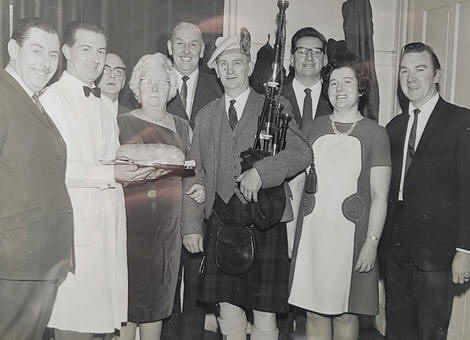
Masonic journey. The photograph below depicts a supper in 1976. Notable
brethren in the photograph are Bro. Joe Sharp PM, Bro. Jim Weir PM and
the piper, Bro John Buchanan, who is the father of our current RWM, Bro.
Alan Buchanan.
Today’s suppers
On Friday 1st February 2019 the Lodge held its
Annual Burns Supper. On this occasion Ian Crozier had assembled a top
table of excellence. It consisted of Ian Crozier himself as Chair, The
Haggis and Artiste, Barry Hamilton - Master of the Lodge, John Merrilees
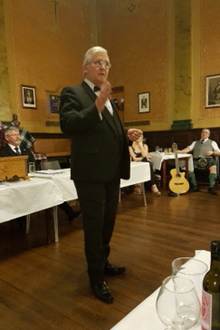
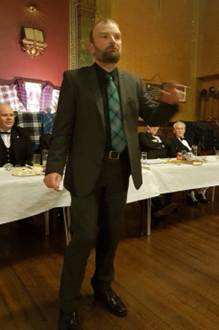
-Immortal Memory of Robert Burns and Artiste, Colin Wilkinson - Toast to
the Lassies, Simon Crozier - Artiste, Alan Buchanan - Artiste, Kirsty
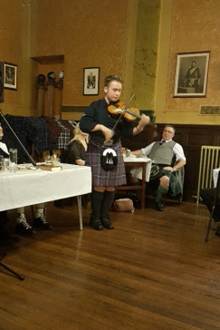
Heggie - Singer, David Hunter - Singer, Findlay Morse - Fiddler and
Singer, Jimmy Gavin - Piper.
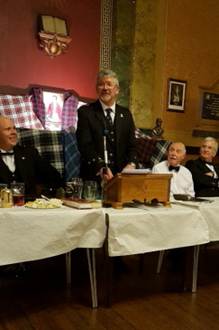
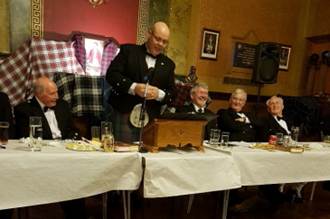
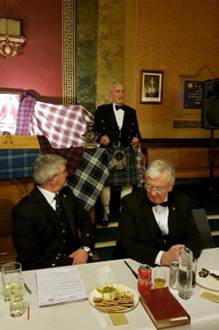
After fine fare the company was treated to array of excellent recitals of the Bards works and some fantastic singing and fiddle playing. A very enjoyable evening was had by all present closing with The Star of Rabbie Burns and Auld Lang Syne. Below are various pictures taken on the evening.
|
|
|
|
The Haggis - Ian Crozier |
Tae the Lassies - Colin Wilkinson |
|
|
|
|
The Immortal Memory - John Merrilees |
|
|
|
|
|
Singer - Davie Hunter |
Fiddler/Singer Findlay Morse |
|
|
|
|
Recital - Alan Buchanan |
Recital - Simon Crozier |
The Travelling Gavel tradition holds a special
place within the Masonic lodges of the Province of Stirlingshire,
serving not only as a symbol of friendly competition but also as a
powerful tool for strengthening bonds across the Province. Each lodge
eagerly anticipates the opportunity to host or challenge for the Gavel,
fostering a sense of camaraderie and shared purpose that transcends the
boundaries of individual lodges. This tradition encourages Masons to
venture beyond the familiar walls of their own lodge, allowing them to
experience the unique atmosphere, customs, and fellowship of sister
lodges within Stirlingshire.
By participating in the Travelling Gavel, lodges
cultivate meaningful relationships that extend beyond formal meetings.
Members meet fellow Masons in a relaxed and social setting, creating
opportunities for conversation, learning, and the sharing of best
practices. These interactions help to reinforce a sense of unity across
the Province, reminding members that, while each lodge is distinct, they
are all part of a larger Masonic family committed to mutual support,
charitable work, and personal development.
The competitive aspect of the Travelling Gavel
adds a lively and engaging dimension to these gatherings, inspiring
lodges to bring their best to each meeting while maintaining the spirit
of good-humoured rivalry. This blend of friendly competition and
fellowship helps to nurture stronger interpersonal connections,
encouraging regular attendance and active participation across the
Province. Ultimately, the Travelling Gavel is far more than a simple
token, it is a dynamic tradition that embodies the values of
Stirlingshire Freemasonry, strengthens ties between lodges, and
celebrates the enduring bonds of brotherhood that unite all Masons in
the Province.
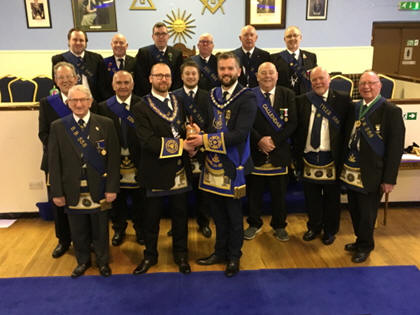
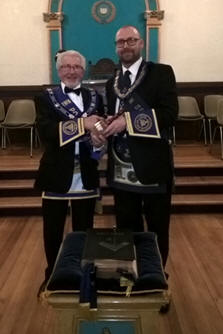
On Thursday 14th March 2018 RWM Bro Barry Hamilton headed a joint deputation from the Lodge into Lodge St Andrew (Denny and Loanhead) No 176 to witness a First Degree. Upon the conclusion of the Degree RWM Bro Archie Mackay of 176 presented the Travelling Gavel to Bro Hamilton. It was however a close-run thing as there were other Lodges present, the largest of them was Lodge Dolphin No 911 who had 13 in their deputation whereas 588 had 14. RWM Bro Barry Hamilton said the Lodge had not had the Gavel for almost four years and he invited any other Lodge to visit 588 on Monday 18th March and take it away. RWM. Barry Hamilton is pictured receiving The Travelling Gavel from RWM Archie Young Mackay as the 588 Brethren look on.
On Wednesday 25th September 2019 the Lodge
visited Lodge Polmont No 793 headed by Right Worshipful Master Brother
Barry Hamilton. On that evening Lodge Camelon No 1456, at the invitation
of Lodge Polmont, were conferring a Fellowcraft Degree on two Candidates
and the Brethren were not disappointed after a very fine working of the
Degree. At the conclusion of the meeting the Right Worshipful Master of
Lodge Polmont No 793 Brother Jim Bennie passed over the Travelling Gavel
to our Right Worshipful Master. Pictured below are the two Right
Worshipful Masters exchanging the Gavel.
Honorary Membership of our Lodge
The tradition of
granting honorary membership is a longstanding and respected practice
within Freemasonry, offering members the opportunity to extend their
fraternal bonds beyond the confines of their own lodge. Honorary
membership allows a Mason to be recognised and welcomed as a temporary
member of another lodge, giving him the privilege of attending meetings,
participating in discussions, and sharing in the fellowship of that
lodge without transferring his primary membership. This practice
reflects the inclusive and open nature of Freemasonry, reinforcing the
principle that brotherhood transcends individual lodge boundaries.
Honorary membership serves as a bridge between
lodges, enabling members to experience different working styles,
rituals, and traditions. It provides a valuable opportunity for learning
and personal development, as Masons can witness the diversity of
approaches within the wider Masonic community. At the same time, it
fosters mutual respect and understanding among lodges, as members gain
insight into the customs, priorities, and charitable endeavours of their
sister lodges. This exposure helps to create a more cohesive and
interconnected Province, where members are not only familiar with their
own lodge but feel a genuine sense of belonging across multiple lodges.
Beyond its practical benefits, granting honorary
membership is a mark of trust and goodwill. By welcoming a brother from
another lodge, the host lodge demonstrates openness, generosity, and a
commitment to the wider ideals of Freemasonry. For the visiting Mason,
it is a gesture of friendship that reinforces the bonds of brotherhood,
strengthens personal connections, and encourages ongoing engagement in
the wider Masonic community. In this way, honorary membership is far
more than a procedural formality, it is a meaningful tradition that
celebrates fraternity, cultivates learning, and strengthens the
inter-lodge relationships that lie at the heart of a thriving Masonic
Province.
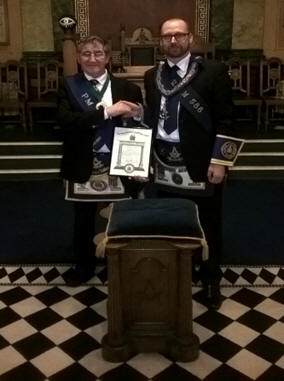
At the Regular Meeting of the Lodge on Monday 1st
April 2019 the Right Worshipful Master Bro. Barry Hamilton presented
Brother Alexander Montgomery Past Master of Lodge Slamannan No 484 with
Honorary Membership of the Lodge. In his response Brother Montgomery
thanked the Right Worshipful Master and the Brethren of the Lodge for
this honour and intimated he would support Lodge Callendar to the best
of his ability. Pictured below is Brother Montgomery receiving his
diploma from the Right Worshipful Master.
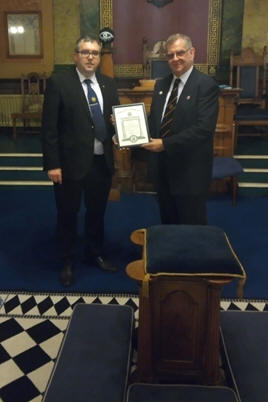
At the first meeting after the 18 months or so
enforced shutdown due to the Pandemic, the Lodge carried out an
exemplification of the Entered Apprentice Degree. On the evening the
Right Worshipful Master, Bro. Colin Chalmers, conferred upon Bro. Billy
Rae a member of Lodge Zetland no 391 Honorary Membership of the Lodge.
Pictured below is Brother Rae with the Right Worshipful Master Bro.
Colin Chalmers.
Young Masons
Degrees
The Young Masons Degree is a relatively new, but
valuable tradition within the Province of Stirlingshire, offering new or
younger Masons from daughter lodges an opportunity to actively
participate in Masonic ritual. These degrees provide a structured
environment where junior brethren can practice the ceremonial aspects of
Freemasonry, build confidence, and develop their skills under the
guidance of more experienced members. By taking part in the degree,
young Masons not only reinforce their understanding of ritual work but
also gain the chance to demonstrate their progress and commitment to
their craft in front of senior brethren from across the Province.
For Lodge Callendar 588, the Young Masons Degree
holds particular significance. It allows the lodge to nurture talent
within the Stirlingshire Masonic community while fostering strong
connections with daughter lodges. By hosting and supporting these
degrees, Callendar 588 helps ensure that the next generation of Masons
is well-prepared, confident, and enthusiastic. The event also
strengthens the bonds of fellowship across lodges, as young Masons gain
exposure to a wider Masonic network and learn from the experience of
their senior counterparts. In this way, the Young Masons Degree is not
just a training exercise, it is a vital part of sustaining ritual
excellence, promoting engagement, and securing the ongoing vitality of
Callendar 588 and the wider Province.
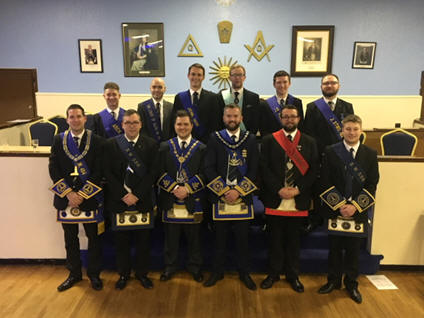
A Young Mason Degree took place on Friday 10th
May 2019 at Lodge St Andrew (Denny and Loanhead ) No 176 led by
RWM Brother Archie Mackay. In particular our Substitute Master Brother
Colin Chalmers and our Senior Warden Brother Calum McArdle, who were
part of the team and done the Lodge proud.
Diplomas and distinguished service membership
In Freemasonry, the awarding of 50- and 60-year
diplomas is a profound acknowledgment of a member's enduring dedication,
loyalty, and service to the craft. These milestones celebrate not just
the passage of time, but a lifetime of commitment to Masonic principles,
including brotherhood, integrity, and the pursuit of moral and spiritual
improvement. Receiving such a diploma is a moment of reflection for both
the individual and the lodge, honouring decades of participation,
mentorship, and contribution to the lodge’s life and community.
Beyond individual recognition, these
long-service awards serve as a powerful reminder to newer members of the
value of perseverance, consistency, and dedication within Freemasonry.
They illustrate that Masonry is a lifelong journey, one that rewards
patience, diligence, and commitment to shared ideals. By celebrating
members who have reached these significant milestones, lodges reinforce
the culture of respect, continuity, and tradition that is central to
Freemasonry, inspiring all brethren to aspire toward long-term
engagement and the cultivation of meaningful relationships within the
lodge.
At the Regular Meeting of the Lodge held on
Monday 4th November 2019, in the presence of Provincial Grand Lodge,
Brother Andrew Walls was presented with a Jubilee Certificate marking
Fifty years as a member of Lodge Callendar. Pictured below is Brother
Walls along with RWPGM Brother Alistair T Marshall and Right Worshipful
Master Brother Barry Hamilton.
At the Regular Meeting of the Lodge on Monday 3rd October
2022, two Brethren were presented with their 50 year diplomas, which had
been delayed due to the Covid lockdown.
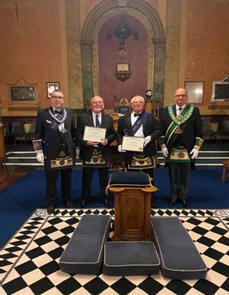
Bro William Nixon MM and Bro David Cox PM were warmly congratulated on
this achievement and thanked for their years of service to the Lodge.
Remarkably Bro Nixon’s proposer and seconded were in the lodge on the
evening in the persons of Bro Jim Weir PM and Bro Joe Sharp PM. To have
your proposer and seconder in the same meeting as you collecting your 50
year diploma is a fairly unique event.
Pictured are the Brethren receiving their 50 year diploma alongside RWM
Bro Colin Chalmers and RWPGM Bro Gordon Sewell.
At the Regular
Meeting of Lodge Callendar No 588, on Monday 3rd April 2023,
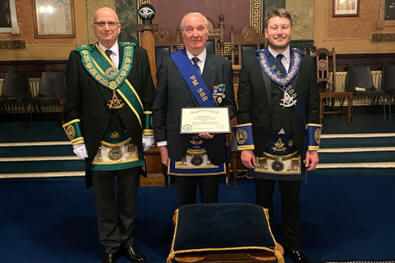
Past Master Brother William Davidson was presented with a 50 year
Diploma in recognition of his long and distinguished service to Lodge
Callendar. Brother Davidson was Initiated into the Lodge on the 4th April
1973 and has served as Master of the Lodge twice, in the years 1992–1994
and 2014–2016 as well as various other offices. Pictured are Bro
Davidson, centre, RWM of Lodge Callendar Bro Calum McArdle and PGM of
Stirlingshire Bro Gordon Sewell.
At the Regular
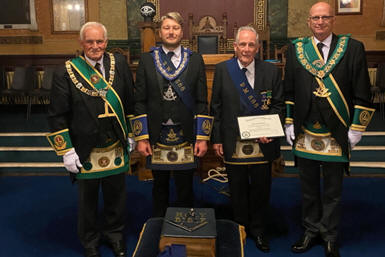
Meeting of the Lodge held on Monday 4th September 2023, in
the presence of the Grand Lodge of Scotland and Provincial Grand Lodge
of Stirlingshire, Brother Andrew A McKinnon, Past Master of Lodge
Callendar No 588 and Past Provincial Grand Master of the Province of
Stirlingshire was presented with a Jubilee Certificate marking sixty
years as a member of Lodge Callendar. Pictured below is Brother McKinnon
along with RWGSW Brother John McKenzie, RWPGM Brother Gordon WS Sewell
and Right Worshipful Master Brother Calum McArdle.
On Monday 25th April 2022 Brother
William Davidson PM and Brother James Weir MBE PM receiving
distinguished service membership of 588 at the hands of the RWM Brother
Colin Chalmers the presentations were made by RWPGM Depute Brother
Stuart Stirling on behalf of PGL. Pictured below are the Past Masters
with the RWM and the PGM Dep.
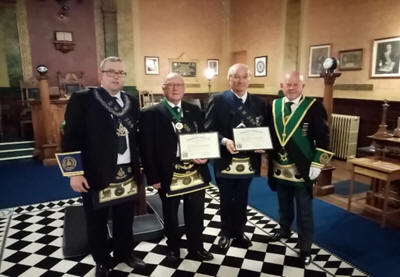
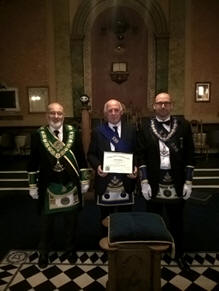
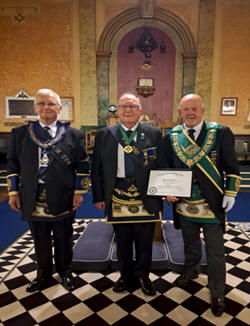
On Monday 20th October 2025 Past Master Brother James Weir MBE, DSM, Hon PG Director of Music, was presented with his Diamond Diploma by Brother Alan Buchanan Right Worshipful Master of Lodge Callendar and Provincial Grand Master Brother Stuart Stirling. Brother Weir was initiated into Lodge Callendar on the 2nd October 1965 and subsequently Passed and Raised by the then Right Worshipful Master Brother James B Paterson. Jim took up his first office the following year and subsequently worked his way up through various offices until reaching the Chair of the Lodge in 1977. Jim returned to the chair of the Lodge from 2016 until 2018, some 39 years after his initial stint. The Right Worshipful Master commented " Jim not only have you been a faithful servant to the Lodge but you have been an inspiring role model for a few aspiring Office Bearers who have used your conduct as a benchmark for the standard required in this Lodge." Pictured below is PM James Weir MBE along with RWM Brother Alan Buchanan and RWPGM. Brother Stuart Stirling.
Our Installations
At Callendar Lodge No. 588, as in lodges across
Scotland, the tradition and ceremony surrounding the installation of a
Master are among the most important events in the Masonic calendar. The
installation is a solemn and structured ritual that marks the formal
transition of leadership within the lodge. It is an opportunity not only
to celebrate the incoming Master but also to reaffirm the values and
continuity of Freemasonry that have guided Callendar 588 for
generations. The ceremonies are conducted with careful attention to
ritual, symbolism, and protocol, reflecting the deep respect for Masonic
heritage that is central to the lodge’s identity.
In Callendar 588, the tenure of the Master is
generally two years, a period that allows for both continuity and fresh
leadership within the lodge. The installation ceremony itself is
meticulously planned and often involves the participation of visiting
brethren, reflecting the wider Masonic community and reinforcing bonds
between lodges. During the ceremony, the outgoing Master formally hands
over the tools of office, symbolising the transfer of responsibility,
authority, and moral stewardship. The incoming Master then assumes the
role with the support of the lodge officers and members, pledging to
uphold the values and traditions of Freemasonry throughout their term.
Beyond its formal structure, the installation is
also a time of celebration and fellowship. Members of Callendar 588 come
together to acknowledge the dedication and service of the outgoing
Master while welcoming the new Master into office. It is a moment to
reflect on the lodge’s past achievements, recognise the contributions of
its members, and inspire all brethren to continue practising the
principles of brotherly love, relief, and truth. The combination of
ritual, symbolism, and camaraderie ensures that each installation
strengthens the lodge’s cohesion and reminds members of the enduring
importance of tradition in Scottish Freemasonry.
Historic Installation
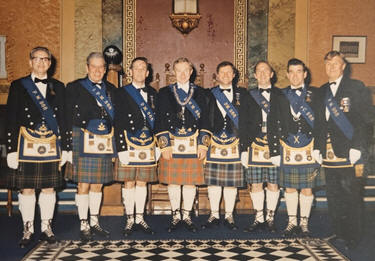
The photograph below details the installation of
Bro. James West of Stow. With him in the picture are
Bro. Joe Sharp P.M, Bro John Whittit P.M, Bro. Andrew McKinnon P.M, Bro.
David Cox P.M, Bro. James Weir P.M, Bro. David Laing P.M and Bro William
Lyon P.M.
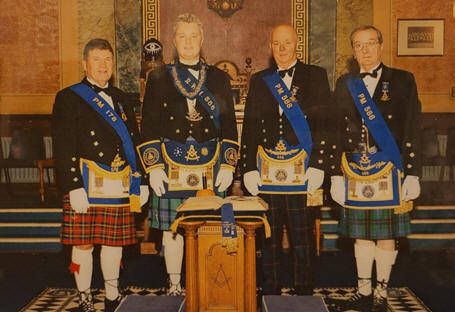
The first
installation after the 125th Anniversary was that of Bro.
Robert Mason on the 2nd of Dec 2012. Pictured below is the
newly appointed R.W.M Robert Mason and his installing team, Bro. William
Davidson P.M. Bro Phil Crozier P.M and Bro John Bell P.M of Lodge Denny
176.
2019 Installation.
.The Annual
Installation of the Right Worshipful Master took place on Monday 2nd
December 2019 where Brother Colin J. Chalmers was Installed as Right
Worshipful Master along with his Office-Bearers. On this occasion the
Installing Masters were Brother Andrew A. McKinnon PM IPPGM and Brother
James Weir M.B.E. Both done a sterling job and were warmly thanked and
congratulated by the Right Worshipful Master and the Brethren present.
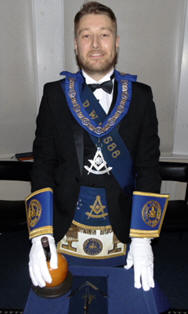
2022 Installation. The Annual
Installation of the Right Worshipful Master took place on Monday 5th December
2022 where Brother Calum J McCardle was Installed as Right Worshipful
Master along with his Office-Bearers. On this occasion the Installing
Masters were Brothers Jamie Findlay and James Weir MBE both from Lodge
Callendar No 588 and Thomas Meikle Lodge Carron No 139
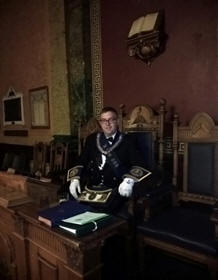
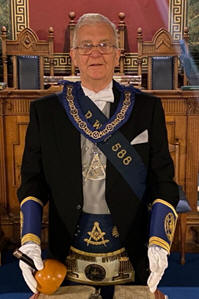
2024 Installation. The Annual Installation of our presiding Right Worshipful Master took place on Monday 4th December 2024 where Brother Alan M Buchanan was installed as Right Worshipful Master along with his Office-Bearers. On this occasion the Installing Masters were Brothers Colin C Chalmers, PM Lodge Callendar No 588. John R Merrilees PM Lodge Camelon No 1456 and Barry I Hamilton PM.
Our brethren who have become Right Worshipful Masters of other lodges
Members distinguished themselves both locally and abroad. In 1927, Bro.
R. L. Robertson became R.W.M. of Lodge St. Michael’s Kilwinning No. 63
in Dumfries. Two years later, Bro. G. Anderson, initiated at Lodge
Callendar, became R.W.M. of Lodge Killarney No. 360 in Cape Town, and
Bro. Alex McQueen was installed as R.W.M. of Lodge Star of the South in
India. In more recent times we have had 3 past masters of our lodge who
have served as RWM in the Linlithgowshire Lodge of Research and
Instruction 1305, Bro. David Laing, P.M, Bro. Phil Cozier, P.M and most
recently in 2025, Bro. Barry Hamilton P.M.
Our current brethren
The photograph below was taken in January 2026 and marks the close to another significant chapter in our lodge history.
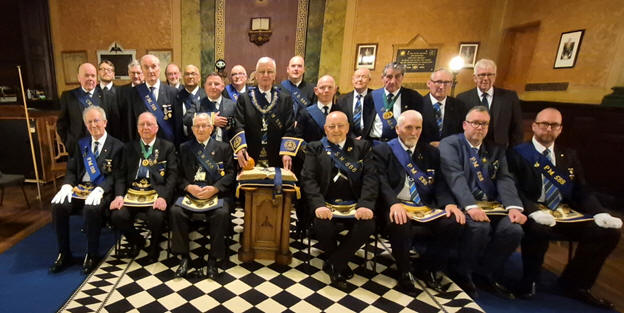
Back row- Bro Calum McArdle IPM SD,
Bro. Alex Campbell, Bro. John Galloway, Sec HPGO, HGO, Bro Nadeem Qurban, Arc,
Bro Alec Croy, Bro. Grant Mitchell, JD, Bro. Bill Gray.
Absent Office bearers
- Bro.
Andrew Ferguson, Almoner, Bro. James H. Chalmers, Chaplain, Bro. Alex
McArdle Jeweller, Bro. Kieran Forsyth, Bard Bro. Reece Ryan, SB, Bro.
Craig Martin, IG.
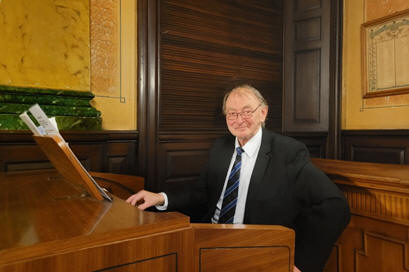
Our Organist
Bro. John Galloway HPGO, HGO, is an affiliate member of Lodge Callendar No. 588, where he currently serves as both Secretary and Organist, and some may not realize it, but his Mother Lodge is Lodge St. John Falkirk No. 16. Bro. Galloway has been our Organist for over 10 years, and well before affiliating with Lodge Callendar in 2019. has brought exceptional dedication and talent to our ceremonies. We are not the only lodge who benefits from his expertise, as his musical accompaniment, heard throughout our sister lodges in the Province of Stirlingshire, adds a distinctive and uplifting dimension to ritual work, enriching the experience for all present. Beyond his contributions at the provincial level, Bro. Galloway holds the prestigious position of Honorary Grand Organist of the Grand Lodge of Scotland, a testament to his skill and commitment to the Craft. Bro. Galloway is an example of the many unseen brethren whose commitment to freemasonry keep our craft alive.
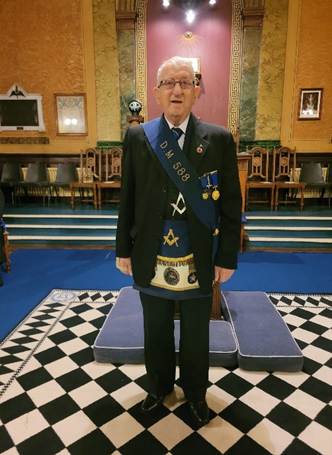
Our eldest member
At the time of writing, Bro. David B. Blair is our oldest member. Bro.
Blair is a shining example of dedication and commitment within our
lodge. As our oldest member, having proudly passed the milestone age of
94, he continues to serve with enthusiasm and grace. With over 60 years
in the craft and currently holding the office of Depute Master, his
contribution is nothing short of remarkable. He was awarded his 60th
anniversary diploma in early 2026. Bro. Blair takes great pride in his
attendance, and throughout his long and distinguished Masonic journey,
he has missed only a handful of meetings, a testament to his loyalty and
passion. His conduct reflects the very essence of Freemasonry:
integrity, fellowship, and perseverance. He inspires every member by
showing that age is no barrier to active service and meaningful
involvement. His wisdom and steadfast presence enrich our lodge, and we
look forward to enjoying his company and leadership for many years to
come. Truly, Bro. Blair is a role model for all.
GRAND LODGE AND PROVINCIAL GRAND LODGE
Below is a table detailing all those from our lodge that have served in Provincial Grand Lodge appointments.
|
Thomas B. Copeland P.M. |
Past Senior Provincial Grand Warden
He was also the first member of our Lodge to hold Grand Rank in
the Grand Lodge of Scotland |
|
William Murphy, P.M. |
Honorary Grand Bible Bearer in the Grand Lodge of Scotland, 1944 |
|
Alexander McNiven, P.M. |
Past Senior Provincial Grand Bard |
|
Thomas Pitcairn, P.M. |
Provincial Grand Secretary, 1929/1945
Substitute Provincial Grand Master, 1945/1949
Right Worshipful Provincial Grand Master, 1949/1957
Substitute Grand Master in the Grand Lodge of Scotland,
1954/1956 |
|
Edward N. Hunter, P.M. |
Past Senior Provincial Grand Warden |
|
Alexander Walker, P.M. |
Past Senior Provincial Grand Warden |
|
Robert Lyon, P.M. |
Past Provincial Grand Inner Guard, 1958 |
|
James B. Paterson, P.M. |
Past Senior Provincial Grand Warden, 1979 |
|
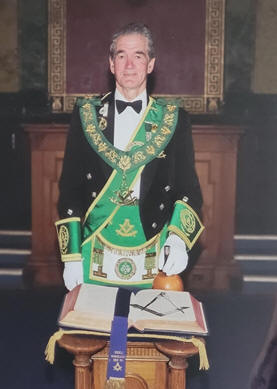
David D. Laing, P.M. |
Past Junior Provincial Grand Warden, 1990
Substitute Provincial Grand Master, 1990/2000
Right Worshipful Provincial Grand Master, 2000 |
|
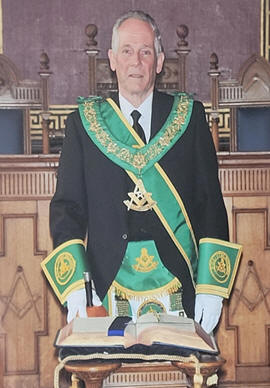
Andrew A. McKinnon, P.M |
Past Provincial Junior Warden, 2000
Substitute Provincial Grand Master, 2000
Right Worshipful Provincial Grand Master, 2010 |
 |
 |
|
Bro. David D Laing, P.M |
Bro. Andrew A. McKinnon, P.M |
In memorial- Brethren who have passed to the Grand Lodge above since
2001
Those brethren of Lodge Callendar 588 who have passed to the Grand Lodge
Above are remembered with deep respect and gratitude. Their dedication,
wisdom, and unwavering commitment to the Craft have shaped the character
and traditions of our Lodge, leaving behind a legacy that continues to
inspire. Through their labour, generosity, and example, they built firm
foundations upon which future generations of Freemasons may stand.
Though absent in body, their spirit endures in our rituals, our
fellowship, and in the values they so faithfully upheld, ensuring their
influence will guide and strengthen Lodge Callendar 588 for many years
to come. The following brethren will be remembered
-
Bro. Robert F. Mason P.M (30th July 1973-3rd December 2012)
-
Bro James Watt P.M (30th Dec 1953- 22nd November 2013)
-
Bro. John Ramage Whitlit P.M (25th March 1937-13th October 2014)
-
Bro. David Finnie Downie Chaplin (27 February 1933- 3rd June 2016)
-
Bro. David Dick Laing P.M and Right Worshipful Provincial Grand Master (11th June 1934- 7th January 2016)
-
Bro. Joseph Sharp P.M and Hon P.G Architect. (28th November 1930- 6th April 2023)
-
Bro. Kevin Lusted (10 Oct 1964-10 Feb 2026)
Summary of Lodge Callendar No. 588: 150th Anniversary
Purpose and Values
The booklet began with a foreword by the current
Right Worshipful Master, Bro. Alan Maxwell Buchanan, emphasizing
that the lodge's strength lies in its people rather than its regalia or
rituals. In a fast-paced modern world, the lodge serves as a sanctuary
for community, service, and moral integrity. Its mission is to preserve
150 years of tradition while remaining relevant to future generations
through personal commitment and charitable work.
Foundations and Early History (1876–1926)
Lodge Callendar was born from the vision of
members of Lodge St. Andrew No. 199, who sought to establish a new
presence in Falkirk. On May 5, 1876, the lodge was officially
chartered by the Grand Lodge of Scotland. Bro. Archibald Galloway
served as the first Right Worshipful Master.
The lodge saw rapid growth, moving to Newmarket
Street in 1888. A significant milestone occurred in 1906 when the
Memorial Stone for the current Temple at Lint Riggs was laid.
The lodge was a pillar of the community during the early 20th century,
supporting relief funds for the Redding Pit Disaster and World War I
efforts. A "Roll of Honour" remains in the lodge today, commemorating
members who served and fell in the Great War.
Architectural and Symbolic Significance
The document highlights the unique beauty of the
Lint Riggs Temple. The architecture incorporates all five noble
orders, with a particular emphasis on the Corinthian order,
characterized by ornate acanthus leaf capitals.
The temple’s North side features four
magnificent stained-glass windows. These do not depict people, but
rather the working tools of the Craft:
- The Square: Representing truth and the Right Worshipful
Master.
- The Level: Representing equality and the Senior Warden.
- The Plumb: Representing moral rectitude and the Junior
Warden.
- The Trowel: Representing brotherly love and the unity of
the Brethren.
Resilience Through the 20th Century (1926–2001)
Despite the Great Depression and World War II,
during which the Temple was requisitioned for military use, the lodge
persisted. The mid-century was marked by the long service of key figures
like Bro. James Ferguson, who served as Treasurer for 47 years.
The period between 1976 and 2001 saw Falkirk
undergo a massive industrial and urban transformation, including the
pedestrianization of the High Street and the creation of the Falkirk
Wheel. Amidst this change, the lodge remained a "bastion of
continuity." It celebrated its Centenary in 1976 and its 125th
anniversary in 2001, fostering international ties with lodges in
Northern Ireland and contributing significantly to local causes, such as
the Dunblane Appeal Fund.
Into the 150th Year
As of May 2026, the lodge continues to honour
its heritage while looking forward. The booklet lists a complete lineage
of Past Masters and current office bearers, led by Bro. Alan Buchanan.
It stands as a testament to a century and a half of "unwavering spirit
of camaraderie" in the heart of Falkirk.
Key Historical Figures & Dates
|
Date |
Milestone |
|
May 5, 1876 |
Charter granted to Lodge Callendar No.
588. |
|
Nov 3, 1906 |
Memorial Stone laid at the Lint Riggs
Temple. |
|
May 1926 |
Golden Jubilee celebrations held. |
|
May 1976 |
Centenary Rededication by the Grand
Lodge of Scotland. |
|
May 5, 2026 |
150th Anniversary of the Lodge. |
As we stand at the threshold of our next 150
years, our hope for Lodge Callendar No. 588 and the wider Craft is not
merely to endure, but to flourish as a beacon of stability in an
uncertain world. To ensure our survival, we must aggressively champion
our three core tenets: Brotherly Love, Relief, and Truth. In an
era of increasing digital isolation, our hope is that the Lodge remains
a physical sanctuary where men of all backgrounds meet on the level,
fostering genuine human connection through Brotherly Love. We envision a
future where our commitment to Relief grows even stronger, demonstrating
to a skeptical world that Freemasonry is a force for tangible, selfless
good within the Falkirk community. Finally, by steadfastly adhering to
Truth, we hope to guide a new generation toward personal integrity and
moral uprightness. We must not fear change, but rather use our ancient
traditions to answer modern needs. Our existence depends on our ability
to prove that these timeless values are more necessary today than ever
before. By standing together, we will ensure that the light of Lodge
Callendar continues to shine for those who follow in our footsteps.
Here’s to another 150 years of our lodge and
Freemasonary.