Hiram Abiff: The Legend, His death and the so-called
secret word of a Master Mason
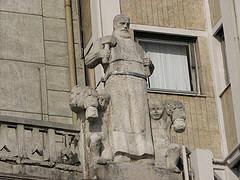 These words are spoken by the Worshipful Master:
"Death has no terror equal to that of the stain of falsehood and dishonor. Of this grand
truth, the annals of Freemasonry afford a glorious example of the unshaken fidelity and
untimely death of our Grand Master, Hiram Abif, who lost his life just before the completion
of King Solomon’s Temple, at the construction of which he was the principle architect."
Who is Hiram Abiff?
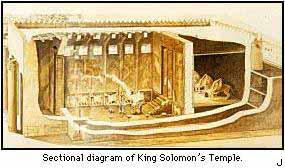 Hiram Abiff is a character who figures prominently in an allegorical play that is presented
during the third degree of Craft Freemasonry. In this play, Hiram is presented as being
the chief architect of King Solomon's Temple. Numerous scholars, both Masonic and non-Masonic,
have speculated that the character may have been based upon one or more Hiram’s that appear
in the Bible. For example, in the Masonic ritual Hiram is referred to as 'the Widow's Son', which
is similar to a biblical reference to a Hiram found in 1 Kings 7:13–14. This biblical Hiram is clearly
not the inspiration for the Masonic Hiram Abiff, as the Masonic drama has a separate character
named "Hiram, King of Tyre".
Hiram Abiff is a character who figures prominently in an allegorical play that is presented
during the third degree of Craft Freemasonry. In this play, Hiram is presented as being
the chief architect of King Solomon's Temple. Numerous scholars, both Masonic and non-Masonic,
have speculated that the character may have been based upon one or more Hiram’s that appear
in the Bible. For example, in the Masonic ritual Hiram is referred to as 'the Widow's Son', which
is similar to a biblical reference to a Hiram found in 1 Kings 7:13–14. This biblical Hiram is clearly
not the inspiration for the Masonic Hiram Abiff, as the Masonic drama has a separate character
named "Hiram, King of Tyre".
Hiram lived or at least temporarily worked in clay banks (1 Kings 7:46-47) in the plain of the
Jordan between Succoth and Zarthan.
Hiram (often spelled Huram), a craftsman of great skill sent from Tyre. 2 Chronicles 2:13-14
relates a formal request from King Solomon of Jerusalem to King Hiram I of Tyre, for workers
and for materials to build a new temple; King Hiram responds "And now I have sent a skillful
man, endowed with understanding, Huram my master craftsman (the son of a woman of
the daughters of Dan, and his father was a man of Tyre), skilled to work in gold and silver,
bronze and iron, stone and wood, purple and blue, fine linen and crimson, and to make any
engraving and to accomplish any plan which may be given to him, with your skillful men
and with the skillful men of my lord David your father." In the original Hebrew version
of 2 Chronicles 2:13, the phrase translated above as "Huram my master craftsman"
is Hiram Abi.
Josephus Flavius in his Antiquities of the Jews (Chapter 3:76) refers to Hiram as an Artificer.
"Now Solomon sent for an artificer out of Tyre, whose name was Hiram: he was by birth of the
tribe of Naphtali, on his mother's side (for she was of that tribe); but his father was Ur, of the
stock of the Israelites."
Because Hiram, King of Tyre provided the labor and the cedar, some have connected
the two, but there is no possible link apart from the fact that they share a name. Hiram
meant ‘noble’ or ‘kingly’ in Hebrew, while Abif has been identified as old French for ‘lost
one’, giving a literal description of ‘the king that was lost.’
"Some of the Masonic seventeenth-century manuscripts [preserving the 'Old Charges']
do not refer to Hiram Abif, which has led some to believe that the character was an
invention of this relatively recent period. However, the name Hiram Abif was only one
designation for this central figure; he is also referred to as Aymon, Aymen, Amnon,
A Man or Amen and sometimes Bennaim. It is said that Amen is said to be the
Hebrew word for 'the trusted one' or 'the faithful one', which fits the role of Hiram
Abif perfectly. But we also know that Amon or Amen is the name of the ancient
creator god of Thebes, the city of Sequenere Tao II. Could there be an ancient linkage here?"
- Christopher Knight & Robert Lomas, The Hiram Key: Pharaohs, Freemasons and the
Discovery of the Secret Scrolls of Jesus
Hiram Abiff is, in essence, identical with many of the Mystery School heroes. The drama
of the Egyptian god Osiris began with his tragic death, the search for his body by Isis, its discovery
and restoration. The Greek god Dionysus was attacked by the Titans. In the course of the fight
he went through many transformations but was finally overcome. The Titans dismembered him,
but in due time the goddess Rhea came to his aid and he rose glorious and entire. This formula is
ancient. It is the concept of the sacred king, who in many instances is lame (which signifies his
dedication), and is destined for sacrifice, that the earth might become regenerated and uplifted
by divine power.
Every Mason knows that it is Solomon's Temple
where Hiram Abiff, known as 'the Widow's Son', was a Master Craftsman. He crafted
the bronze pillars, a bronze tank, and many other gold and bronze items (kings 7:13 - 46).
His name is Huram in this verse. According to the Ritual tradition he is killed
before the completion of his work. The Bible and the ritual place him in Jerusalem.
But the 23rd through the 24th focus of the Masonic Scottish Rite degrees describes a temple in
the Sinai. Moses is in attendance and Aaron conducts a ceremony, perhaps a funeral. This unusual
story does not coincide with the building of the Jerusalem Temple or the biblical story. It does
however indicate that at the time everyone was in Egypt. It also indicates that someone was killed
and Moses and Aaron are somehow part of the story.
We know that the KJ Bible doesn't mention Hiram's death however there is one skeleton and 3 skulls
in the focus of the 22nd degree. The 'Focus' of the degrees are not secret and have been published.
They are all on a separate page for all to read and study. (Degrees of the AASRF)
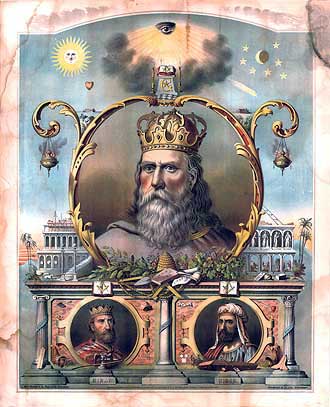 The three Grand Masters mentioned often in the rituals concerning
the building of the Temple are: Solomon, King of Israel; Hiram, King of Tyre; and Hiram Abiff.
In early times, some religions regarded Deity in three aspects. The secrets (mysteries) known
only to these Three Grand Masters typify Divine Truth, which was known only to Deity, and was not to be
communicated to man until he had completed his own spiritual temple. Once these
secrets were attained, a man could reap the rewards of a well-spent life, and travel to
the unknown country toward which all of us are traveling. Tyre, by the way, means stone or rock.
From The legend of Hiram. Hiram
is described as a great allegory and is called "The Master of the Works".
The three Grand Masters mentioned often in the rituals concerning
the building of the Temple are: Solomon, King of Israel; Hiram, King of Tyre; and Hiram Abiff.
In early times, some religions regarded Deity in three aspects. The secrets (mysteries) known
only to these Three Grand Masters typify Divine Truth, which was known only to Deity, and was not to be
communicated to man until he had completed his own spiritual temple. Once these
secrets were attained, a man could reap the rewards of a well-spent life, and travel to
the unknown country toward which all of us are traveling. Tyre, by the way, means stone or rock.
From The legend of Hiram. Hiram
is described as a great allegory and is called "The Master of the Works".
Hiram Abiff is, in part, a composite of three biblical figures; Betzalel, Adoniram and Hiram Abi.
Thus the figure of Hiram Abiff combines the wisdom of Betzalel and the supervising skills of Adoniram with
the metal working skills of Hiram Abi, and adds those of a Master Mason. The question remains,
who is he really? He is a symbolic character whose meaning we must discover if we are to understand
the Legend. Another link to info -
The legend of Hiram;
Exerpt: "It is not intended to teach resurrection, no matter how many Masonic
students and officers state that that is his purpose. The falsity of the resurrection teaching is obvious
within the legend. You don't resurrect someone and then turn around and bury him again."
"In Plato's Timaeus, there appears the earliest known equation of
the Creator with the 'Architect
of the Universe'. The Creator, in the Timaeus, is called 'tekton', meaning 'craftsman' or 'builder'.
'Arche-tekton' thus denoted 'master craftsman' or 'master builder'. For Plato, the 'arche-tekton'
crafted the cosmos by means of geometry."
- Baigent & Leigh, The Temple and the Lodge
"Although Freemasonry require each of its Candidates to confirm his belief in God, it does
not expand on the subject but leaves religion and its practice to the individual Mason. As a result,
men of all religious persuasions have been able to join in the study of Freemasonry's moral and
philosophical principles."
- W. Kirk MacNulty, Freemasonry - A Journey through Ritual and Symbol
From the KJB; In Kings 5:3-6, Hiram (meaning Father), the King of Tyre and
Solomon apparently did not worship the same god. This is because of the wars they had when David
was King. In Kings 5:3....and Solomon calls him, 'MY God' in verse 5. Does this indicate Hiram had
a different God? Irregardless, they formed an alligence that would benefit both parties in spite
of their religious differences.
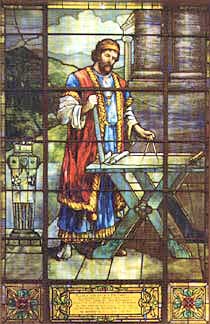 In the legend, Hiram Abiff, the skilled artificer, was the Son of a Widow of the
Tribe of Naphtali. (known as Huram Abi) The earlier accounts of Hiram are recorded in the
1st Book of Kings, 7:13 & 14. Hiram Abiff is the Master Mason in charge of the days
assignments in the building of Solomon's Temple in Jerusalem. He writes these
assignments on a "Trestle Board".
In the legend, Hiram Abiff, the skilled artificer, was the Son of a Widow of the
Tribe of Naphtali. (known as Huram Abi) The earlier accounts of Hiram are recorded in the
1st Book of Kings, 7:13 & 14. Hiram Abiff is the Master Mason in charge of the days
assignments in the building of Solomon's Temple in Jerusalem. He writes these
assignments on a "Trestle Board".
The trestle board is that drawing board, supported upon a
trestle, on which, anciently, the Master Builder drew his designs. The Terms Trestle
Board and Tracing Board seem to have been used
interchangeably through the ages, and although they appear to have a common
origin, today they should be given two separate meanings. The term 'Tracing
Board' has come to mean the small boards or canvases, sometimes replaced by
slide projections, on which the symbols peculiar to each degree are displayed
for the purpose of explanation to the Candidate.
The ceremony in which a brother is elevated is taken from the VSL and
symbolizes wisdom, strength and beauty, which are relevant not only in the
construction of the ark but also for their moral significations to the candidate
as an individual. The tracing board of the degree is unusual in that it contains
symbols of many of the other orders in Masonry.
It is believed that the name tracing board is a corruption of the old
Tressel or Tracel Board used in lodges in the late eighteenth century to display
the Masonic hieroglyphics, and in many lodges displayed on a trestle in the
center of the lodge. The lectures further compare the use of the tracing board
by the Master in the instruction of his lodge, with the Volume of the Sacred Law
as a means by which God may perform a similar function to mankind. It is
regarded as the spiritual tracing board of God . . .
The term Trestle Board, used in the context of a drawing board or drafting
table, is in itself a Masonic symbol of moral law. This symbol is displayed in
many lodges as a small board, often a chalkboard, with various lines and designs
depicted, on an easel-like frame in the East, near the Master. Whether it is
called Trestle Board or Tracing Board, it is this symbol which is one of the
jewels of Freemasonry.
see
Trestle Board
and Trestle board
Freemason Symbols....Learn the ancient symbolism of Freemasonry.
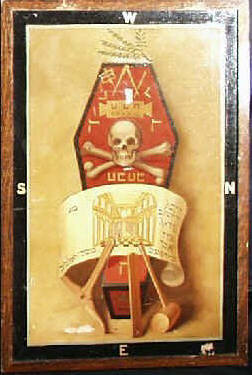 In the bible Hiram is skilled in work on gold, silver, bronze and iron, stone and wood. He is experienced
in engraving and can execute any design given to him. Chronicles 2:13 - 4:22. The goal of our
ancient operative brethren was to become masters, so they might posses those secrets which
would enable them to practice the art of the builder, no matter where they traveled, even
in foreign countries. Their skill included Geometry. As we progress further into this site, we see
that the Great Pyramid of Egypt was built using Geometry as were the great cathedals of
Europe built by the Templars.
In the bible Hiram is skilled in work on gold, silver, bronze and iron, stone and wood. He is experienced
in engraving and can execute any design given to him. Chronicles 2:13 - 4:22. The goal of our
ancient operative brethren was to become masters, so they might posses those secrets which
would enable them to practice the art of the builder, no matter where they traveled, even
in foreign countries. Their skill included Geometry. As we progress further into this site, we see
that the Great Pyramid of Egypt was built using Geometry as were the great cathedals of
Europe built by the Templars.
"One who would walk in the Way of the Craftsman must
do one thing more. He must remember, always, that he is building a temple to God. He is building
an edifice in conciousness in which he, himself, is an individual stone. In time, each human being
will square his stone and place it in that temple, and when that temple is complete, God will behold
God in the Mirror of Existence and there will be then, as there was at the beginning, only God."
- W. Kirk MacNulty, The Way of the Craftsman
"...Each Master Mason becomes his own architect. Each supervises the building of that "temple not made by
hands." Each builds into his structure beauty, harmony and knowledge to the extent he is willing to work."...The Craft
and Its Symbols, p. 84, 1974, Allen E. Roberts, MaCoy Publishing and Masonic Supply Co.
Most Masons also know that Hiram is a symbol of man's journey
through this life and the symbolism used refers to man finding a better life beyond this one. The
ritualistic 'raising' of the dead 'Master' is also purely symbolic. However it resembles
an ancient Egyptian ritual wherein the dead King is 'raised' to a position of immortality
in the afterlife. This now symbolizes a 'spiritual awakening'. An awakening that shows
us conclusively that there is 'life after death'. This is a Mystery and most Masons don't get
this without more study and research. Often the symbolism is vague and not
understood immediately and it is left up to the initiate to understand it in his own way.
"Death is the opener, the one giving vision; death is the greatest and loveliest change that
the heart of nature has in store for us." - G. de Purucker, Golden Precepts of Esotericism
"O Death, where is thy sting? O Grave, where is thy victory?" We are all familiar with these
beautiful words of Paul, but alas, how little real consolation have they given to bereaved hearts!
For there has been no teaching or experience to bear out their promise of divine assurance. And
yet the truth has been close beside us all the time, whispering to our hearts in the very voice
of our own love for our departed:"
Spiritual man is eternal: there are no dead.
Love itself is the evidence of our spiritual survival -- true love, which is unselfish and undemanding,
pure, forgiving, and indestructible. Can we ever cease to love, though we may at least cease continually
to mourn, those who have preceded us into the Land of Light? Our love, just because it is
indestructible, must spring from something in us which is also undying, for how can a quality
be greater than the source from which it springs? from
Death
More about Masonry
The Egyptian Connection
"Tracing the ritual back to Egypt 3500 years ago and actually
finding the real 'King that was Lost' amazingly fit our Hiram Abiff perfectly."
quote taken from
The Hiram Key by Christopher Knight and Robert Lomas.
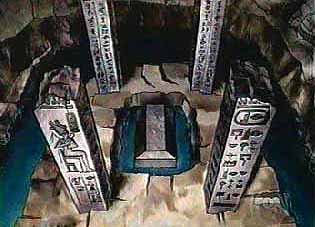 Egypt had to come into existence thousands of years ago in the age
of the gods and the distinction between the 'two lands' had been created through the murder
of Osiris by his evil brother Set(h).
Egypt had to come into existence thousands of years ago in the age
of the gods and the distinction between the 'two lands' had been created through the murder
of Osiris by his evil brother Set(h).
Set(h) tricked his brother Osiris into getting into a coffin. He then
quickly sealed it up and threw it into the Nile. Isis found the coffin and released Osiris. Set(h)
found Osiris again and cut him up into 14 pieces and scattered them all over Egypt. Isis gathered
all the pieces but one. The missing piece was the phallus. After reviving Osiris again, and with the
help of Thoth, she magically fashioned a new phallus and sat on it conceiving Horus. Horus
became known as the 'Widow's Son'.
After Horus is conceived, Osiris becomes 'the King of The Dead' and is transported to
the 'afterlife'. The afterlife (also referred to
as life after death, the hereafter, or the great unknown) is the belief that the consciousness and/or mind
of a being continues after biological death occurs. The term reincarnation refers to an afterlife
in which only the "essence" or ego of the being is preserved. In the "afterlife" we could be assigned another life on
Earth or possibly somewhere within the standard universe. Freed from all material attachments, we may
dwell there eternally as a matured human spirit.
Passing now to the consideration of the original charcterteristics and attributes of Osiris
we find that the oldest religious texts known to us refer to him as the great god of the dead, and
throughout them it is tacitly assumed that the reader will understand that he once possessed
human form and lived upon earth, and that by means of some unusual power or powers he was
able to bestow upon himself after the death a new life which he lived in a region over which he
ruled as king, and into which he was believed to be willing to admit all such as had lived a good
and correct life upon earth, and had been buried with the appropriate ceremonies under the
protection of certain amulets, and with proper recital of certain "divine words" and words
of power. The worship of Osiris is, however, very much older than these views, which is
clear, could only belong to a people who had advanced to a comparatively high state of
civilization and mental/spiritual development.
Part of the story of Hiram is "spiritual", part is physical. Going from the physical to the spiritual is
the 'goal' of mankind if we want to reside with God in Heaven. But as we progress we find that the
soul does not die and it's our dead King Hiram who eventually leads us to this truth.
Horus was himself a real boy who grew to manhood and fought
the evil Set(h) in a mighty battle in which Horus lost an eye and Set(h) lost his testicles.
People viewed the battle and the gods; Isis, Horus, Set(h) and Osiris to be mythical but physical
evidence started turning up all over Egypt that proves these gods were in fact real. Mummies,
Tombs, literature, ect., all point to these mythical gods as being real people. see
Osiris Found
and see this private site by Richard Hogland.
Enterprise Mission.
This site talks about the secret mission the Egyptians are conducting to look behind the "door" that
Rudolph Gantenbrink's robot found in 1993. More on the next page about the 'secret rooms' in the pyramid.
The reason for the murder of our 'lost' King is tied to the split in the 'two lands' of Egypt
and the two brothers Set(h) and Osiris. A new king emerged that restored the two lands together as one.
This is considered 'recorded history' as far as the Egyptians are concerned. They do not know however
that the king that died was originally from Babylon. His name is very familiar to most people.
Matthew 13:35, "I will utter things
which have been kept secret from the foundation of the world."
With this information we ask you to keep in mind that there is always 'another side to any story'.
In this instance it is the Hebrew point of view versus the Egyptian. The major points of the untold story
are by the Egyptian historian Manetho, who was
an Egyptian historian and priest from Sebennytos (ancient Egyptian: Tjebnutjer) who lived during the
Ptolemaic era, ca. 3rd century BC. Manetho wrote the Aegyptiaca (History of Egypt). His work is of
great interest to Egyptologists, and is often used as evidence for the chronology of the reigns of pharaohs.
In his work Manetho tells us what really happened during the Hyksos dynasties.
A contemporary of Philadelphus was Manetho, a High Priest at Heliopolis, and a
learned man, also a prominent scribe of the Great White Brotherhood, who had access
to the secret teachings of the Order. Manetho was also master of the ancient Egyptian
writing, or Hieroglyphics, which, in the Third Century B.C., was becoming archaic and
could not be generally read. The Egyptians were at that time reading a modern version
of the ancient writings, the Demotic, and Greek was becoming still more popular.
Philadelphus commissioned Manetho to compile a history of Egypt, and particularly a
text of the mystic philosophy of the Secret Schools of the Great White Brotherhood
and Rosicrucian’s.
This knowledge, we are told, was mainly contained in the Hieroglyphic
inscriptions in the library of the priesthood at Ra. It will be recalled that Amenhotep IV
(Akhnaton) declared Ra, the sun, to be a physical manifestation or symbol of the great
sole God. This library, therefore, must have contained the great truths of his monotheistic
religion, and the truths which the thinkers with which he surrounded himself at
Tell el-Amarna. Much that we know of the outer or profane history of Egypt
came about through this compilation by Manetho. In fact, it is generally conceded that
Plutarch acquired much of his information from this source. In a book of Manetho's,
called Sothis, of which fragments only are to be found in the writings of others, appears
the following letter to Philadelphus, from Manetho, telling of his efforts to compile the ancient wisdom....
"We must make calculations concerning all the points which you may wish us to examine
into, to answer your questions concerning what will happen to the world. According to your
commands, the sacred books, written by our forefather, Thrice-greatest Hermes, which I study,
shall be shown to you. My Lord and King, farewell."
Manetho's greatest work was his Egyptian
history, which was done in three books, and in the Greek language. It is famous because it is the
only work in Greek based upon a full knowledge of the Egyptian sources. Fragments of these works
come to us today in the writings of Fiavius Josephus and Julius Africanus. The former is a more
reliable authority and refers to Manetho in his
treatise, Against Apion.
In the History of Egypt by Manetho, there is an interesting reference to Moses, which shows him also to have been an initiate
of the Great White Brotherhood of Egypt, and to have transmitted their knowledge in a veiled manner to his people. The excerpt reads:
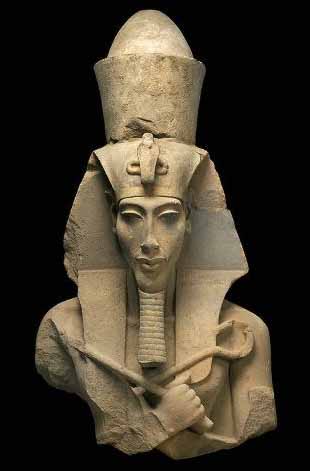 "Moses, a son of the tribe of Levi, educated in Egypt and initiated at Heliopolis, became a High
Priest of the Brotherhood under the reign of the Pharaoh Amenhotep". Refer to Dr. Ross Kelly's
2nd Intermediate Period, in which
we see the succession of Egyptian Kings and the Hyksos pharoahs aligned together during the same time frame.
These are completely "seperate" rulerships, seperate locations, and seperate groups of people. The HYKSOS had their
own dynasty that ran alongside the true Egyptian 12th - 17th dynasty. Abraham, Joseph and all the' Hibru' lived at Avaris/Memphis.
"Moses, a son of the tribe of Levi, educated in Egypt and initiated at Heliopolis, became a High
Priest of the Brotherhood under the reign of the Pharaoh Amenhotep". Refer to Dr. Ross Kelly's
2nd Intermediate Period, in which
we see the succession of Egyptian Kings and the Hyksos pharoahs aligned together during the same time frame.
These are completely "seperate" rulerships, seperate locations, and seperate groups of people. The HYKSOS had their
own dynasty that ran alongside the true Egyptian 12th - 17th dynasty. Abraham, Joseph and all the' Hibru' lived at Avaris/Memphis.
It is entirely possible for Moses to have been born in the period right before Ahmoses became King of Egypt.
That would mean he grew up in the Seqenenre Tao household with a woman named "Thutmose" as his adoptive mother.
The "mose" in her name and her other son's names was also given to him as was the custom.
The cronology of the
"New Kingdom" shows Amenhotep 1 just after Ahmoses.
This article by Josephus in his "Antiquities of the Jews" confirms Moses led an army against Ethopia.
His stepmothers name was Thermuthis, which we've been told is the same as 'Thutmose'. She also ruled along side
her son as co-regent for several years as he was only 16 years old at the time. She later took the kingly name of 'Ahmoses' also.
see Moses makes war against the Ethopians
Moses was elected by the
Hebrews as their chief and he adapted to the ideas of his people the science and philosophy
which he had obtained in the Egyptian mysteries; proofs of this are to be found in the symbols,
in the initiations, and in his precepts and commandments. The wonders which Moses narrates
as having taken place upon the Mountain of Sinai, are, in part, a veiled account of the Egyptian
initiation which he transmitted to his people when he established a branch of the Egyptian
Brotherhood in his country, from which descended the Essenes. The dogma of an 'only God'
which he taught was the Egyptian Brotherhood interpretation and teaching of the Egyptian King
who established the first monotheistic religion known to man. The traditions he established
in this manner were known completely to only a few of them, and were preserved in the
arcane of the secret societies, the Therapeutics of Egypt and the Essenians."
The Rosicrucian Order
Akhenaten was the son of Amenhotep III and Queen Tiy, a descendent of a Hebrew tribe.
Sigmund Freud suggested that Moses WAS
Akhenaten. Our debate on
this subject aligns Moses with the 17th dynasty and pharaoh Ahmoses, who may have written a detailed
account of the plagues of Egypt as described in Exodus, called
The Ipuwas papyrus.
We think that shortly after Moses was
born the Egyptian Royal families moved back to Thebes because most accounts say
that Moses grew up in Thebes. Seqenenre Tao II was killed while living at Thebes and Ahmoses
began his campaign to rid the country of 'the invaders' at Avaris. So Moses could not have
been a prince under Amenhotep I, 1526–1506 BC, but Amenhotep was probably King when Moses began
the Exodus. Josephus recorded that Moses' step-mother "Tuthmoses" brought him before the king that he
might lead a army to repel the Ethiopians. But there is a view that the Ethiopians weren't the only threat to Egypt
and that Moses may have led an attack against the 'Hibru'.
More proof is based largely on the Santarini volcanic eruption that occured around 1550 BC.,
which coinsided with the Exodus and was recorded in
The Ipuwas papyrus.
Some have interpreted the document as an Egyptian account of the Plagues of Egypt and the Exodus in the Old Testament of the Bible,
and it is often cited as proof for the Biblical account by various religious organisations. The dating of the original composition
of the poem is disputed, but several scholars, have suggested a date between the late 12th dynasty and the Second
Intermediate Period (ca. 1850 BCE - 1600 BCE).
Those who interpret the Exodus as a historical event generally place it later, in the
reign of Ramesses II. This, in spite of the fact that there is absolutely no
evidence from archaeology or from any documents that Ramesses II had to deal with the
Ten Plagues or anything like them, or that he chased after runaway slaves.
This brings us to the 1st point of the study:
When Moses wrote the Torah it is very likely he did not know the names of the Hyksos (Northern Lands)
pharoahs. It is also likely that as the bible says, "A new king came to power in Egypt that did not know
Joseph or Abraham". Exodus 1:8. This would be Kamose, first born son of Seqenenre Tao II in the
17th dynasty of Egypt.
As quoted from Exodus 1:15, a pharaoh orders the killing of all the
newborn Hebrew babies. This pharaoh wasn't Kamose or anyone in his royal court at Thebes.
The 'pharaoh' in question was the evil Apophis, the pharaoh who ruled from the Hyksos capitol at
Memphis/Avaris. This seems to be a hidden factor in the KJB, but it leads to many more 'secrets'
recently uncovered by various archaeologists.
Most Masons who come to this site know that our title page,
'Hiram Abiff - King of Egypt' - is just a play on words which connects Hiram with the real King,
Seqenenre Tao.. This was taken from the book The Hiram Key, by Christopher Knight and
Robert Lomas, published in 1997. Knight and Lomas were heavily criticized for not providing the
sources for their work.
In tribute to them, because it was their book that inspired this web site, it is our great
honor to provide the sources and alot more.
As we shall see, the view from the 'other side' will expose more Mysteries, which account
for only one of many of God's secrets we shall explore on this web site.
Matthew 13:35, "I will utter things
which have been kept secret from the foundation of the world."
The real evidence to establish the validity of The Hiram Key comes from Josephus...
see
Moses attacks Ethiopia.
Is it possible that Moses was sent on another mission after the Ethopians were expelled? We have to conclude that this text has been
altered to hide the fact that Moses actually fought against the Hebrews/Hyksos and subdued them. Our reasons for this theory
will come to light in the following pages.
Our Hiram Forward 1 page also presents the facts that Simcha Jacobovici found and uses in
his documentary "Exodus Decoded" which is only a small portion of the supporting evidence
not used by Knight and Lomas in The Hiram Key.
The new Hebrew faith, or as they call it, Judaism was not established until
Joshua got to Canaan.
Joshua was a lieutenant under Moses. He is credited with the first 'editing of the bible' after Moses
was gone. He may have even served in the Egyptian army as an officer. This clue also points
to Josephus' story about Moses as the Egyptian Military leader under Thutmose, (see Moses attacks above).
As we said, this is actually Kamose's mother. Military rolls of the Egyptians show the officers frequently included
multiple nationalities.
Why does the bible not mention the death of Hiram?
It is a fact that the scriptures mention nothing about Hiram's death but the
Masonic Degrees say Hiram died before Solomon’s temple was completed. As we read
the scriptures we realized that the story wasn't really true but had an allegorical lesson in it.
Several Masons even wrote us and said the story wasn't really true!
"Among the traditions
of the Order there is a legend referring to the tablets used by Hiram Abiff as a
Trestle-Board on which to lay down his designs. This legend, of course, can lay no
claim to authenticity, but is intended simply as a symbol inculcating the duty of
every man to work in the daily labor of life after a design that will construct in his
body a spiritual temple."
Although this is a valuable allegorical lesson, it doesn't explain the 'death' at all! But the
murder of Seqenenre does. Even more evidence comes from the 22nd and 23rd Masonic degrees,
which takes place in the Sinai, in Egypt, which you will see on
Hiram Forward 1.
We actually find Moses and Aaron in attendance at a funeral.
Eventually, this tradition about the murder of the king filtered down in garbled form
into the secret traditions of the Jews, who had originated from Egypt proper and eventually
assimilated much Egyptian cultural tradition. The secret tradition had been passed down over
thousands of years to the Essenes in Qumran, who had left some of their most important
and sacred writings in secret passages beneath the Temple of Jerusalem, shortly before the
sack of Jerusalem by the Romans in 70 AD.
The secret words used in the Third Degree ceremony which is
the Master Mason raising ceremony are spoken in a whisper and are never spoken out loud.
’Ma’at-neb-men-aa, Ma’at-ba-aa’ (This is not correct)
These words are pure ancient Egyptian meaning:
’Great is the established Master of Freemasonry, Great is the spirit of Freemasonry’.
This site that uses these words translated
as ‘Ma’at’ for ‘Freemasonry’ is incorrect, but they say because there is no other modern
single word that comes close to the original complex concept that conveyed a whole bundle of ideas
around ‘truth, justice, fairness, harmony and moral rectitude as symbolized by the regular purity of the
perfectly upright and square foundations of a temple’. Ma’at was an attitude to life that blended
the three most important values that mankind possesses, namely the knowledge of science, the
beauty of art and the spirituality of theology.That is the craft of Masonry.
Ma'at, Spelled [muh-aht, mey-uht] simply means 'Justice' which was symbolized by Isis
or in Egyptian Religion; the goddess personifying law and righteousness..
The few correct words have survived intact over such a vast period of time. They have been viewed
as the ‘magic words’, the incantation which made the resurrection of the new candidate something
more than symbolic.
Kamose (1551 B.C.) was raised as the first candidate following the
murder of his father, but he only lived 3 more years at which time, evidence shows us that Moses took over
as the young Ahmose was not ready to lead an army. This is when Thutmose (the queen - Ahmose
who ruled as co-regent) pleads with the young king to let Moses to lead the attack. (see Josephus above.)
On January 12 (approximately), 1538 B. C., Thutmose I was crowned succeeding Amenhotep
I. He owed his position to his wife, Ahmose, who was the first woman to become a member of
the class on equal terms with the men. The discussion regarding her admittance (preserved in
the Rosicrucian Archives) forms an interesting story and reveals the origin of some of the
doctrines of the equality of the sexes. THE Rosicrucian Order had its traditional conception and
birth in Egypt in the activities of the Great White Lodge. {p. 42} In a translation from the original
hieroglyphic inscriptions in The Book of the Dead, by Sir E. A. Wallis Budge, we find these
admonishments, "to allow no one to see it," nor was it to be recited to even a close friend,
for further we find: "never let the ignorant person, or anyone whatsoever look upon it"; also
"the things which are done secretly in the hall of the tomb are the mysteries ..."
from Rosicrucian
Some say that in the 12th century, the Knights Templar dug
up sacred scrolls and substantial quantities of treasure in secret passages under Herod's Temple, and
began to practice the rites mentioned in the ancient scrolls, which they believed to be the
purest form of Christianity before it was contaminated by the Roman mystery religions. Among
these was the tale of Hiram Abiff, which would be a garbled echo of the story of the murder of Seqenenre
Tao. After the Templars were suppressed in the early 14th century, their traditions spread
in secret in proto-Masonic societies that are the forebears of modern Freemasonry.
The theory goes that the true Egyptian kings like Sequenenre Tao and
his predecessors possessed knowledge of a secret ritual that was supposed to create a king by allowing the
king-to-be to commune with the gods and gain from them his right to rule. Apophis and the
previous Hyksos pharaohs never had knowledge of this king-making rite, and as Apophis could
feel his authority slipping, he wanted it desperately. So he enlisted his new Grand Vizier to
come up with a plan that would allow him to obtain these secrets. He turns to Joseph,
who was vizier around 1598 - 1550 B.C.E. Did Joseph send his brothers, Simeon and Levi to
do the deed? The writers of the Hiram Key think so.
Remember how Jacob says in Genesis 49:5 "Simeon and Levi ..their swords are
weapons of violence." 49:6 "Let me not enter their council, let me not join their assembly,
for they have killed men in their anger ...7: Cursed be their anger, so fierce and their fury so
cruel! I will scatter them in Jacob (Israel) and disperse them in Israel." There is much, much
more to this story.
Sometime before the completion of Solomon's temple, the legend
has Hiram being brutally attacked and struck three times with 3 different objects by 3 ruffians
who's names are Jubela, Jubelo, and Jubelum, who demand that Hiram reveal to them the secret
'Master's Word'. Confronted at each of the Temple's exits, each time he refuses. The last blow to his
head with a heavy stone maul killed him. The moral of the story is that Hiram would rather die than break
his oath to his fellow Masters not to reveal 'the word'.
The newly revised ritual says the wounds Hiram receives--to the head, throat, and
heart--are said to represent the spiritual death imposed on humanity by the forces of tyranny
and superstition: the head wound represents the death of thought, the throat wound signifies
the suppression of free speech, and the wound to the heart implies that human feelings disappear
when they are denied free thought and free speech.
Widow's Son 2
has the original ritual.
As the legend continues; The body laid unattended to for several
days. Men from Solomon’s Temple found it and symbolically 'raised' the 'Master' from the dead.
This ritual is thousands of years old and goes back to Horus, son of Osiris being born of a widow
after Osiris was murdered. The 'Masters Word' at that time was used by Isis to revive Osiris....
In this instance, and according to The Hiram Key by Christopher Knight and Robert Lomas,....
after Sequenenre was murdered the 'Word' was lost. Only 3 people had it, the two High Priests
and the King. The two priests are murdered after they also refuse to divulge the 'word'.
In the final degree or third degree Hiram is 'raised' from his grave by the Master
in a special way. This does not represent the resurrection of Jesus in any way shape or form.
This is a 'spiritual awakening', a realization, if you will, of the reality of Life After Death.
We know the Egyptians used magical incantations and ritual in much the same way to insure
their King reached the 'Afterlife'. These rituals were never written down, but were passed
on by word of mouth only and the initiate or candidate took an oath never to reveal what
he was taught, least he die a terrible death.
"And the Spirit came to him in haste when it raised him.
Having given its hand to the one lying prone on the ground, it placed him firmly on his feet, for he had not yet stood up.
He gave them the means of knowing the knowledge of the Father and the revelation of his son.
For when they saw it and listened to it, he permitted them to take a taste of and to smell and
to grasp the beloved son". Masons, does this sound familiar?..
from The Gospel of Truth
in the Nag Hammidi scrolls.
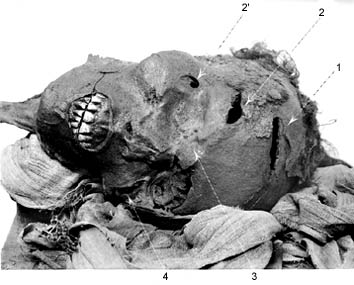 It just so happens that the mummy of Sequenenre Tao II, 17th
dynasty of Egypt, has three different and very distinctive wounds to it's skull. Forensic
science has not only identified the objects that killed him but the position he was in when
he was killed and it was not on the battle field. The wounds on Sequenenre's head match
exactly those described in the legend of Hiram Abiff. The mummy, the forensic evidence
and an overview of the Royal line of Egyptians are on Widow's Son 2 and
3.
"A previous blow to the head [ the top gash ] showed signs of healing".
Experts suggest there must have been brain damage caused by this blow because one arm of
the mummy was contorted."
It just so happens that the mummy of Sequenenre Tao II, 17th
dynasty of Egypt, has three different and very distinctive wounds to it's skull. Forensic
science has not only identified the objects that killed him but the position he was in when
he was killed and it was not on the battle field. The wounds on Sequenenre's head match
exactly those described in the legend of Hiram Abiff. The mummy, the forensic evidence
and an overview of the Royal line of Egyptians are on Widow's Son 2 and
3.
"A previous blow to the head [ the top gash ] showed signs of healing".
Experts suggest there must have been brain damage caused by this blow because one arm of
the mummy was contorted."
Hiram Legend; "After the death of Hiram Abiff, the two kings
resolved not to visit the Vault, nor communicate the ineffable Name, until they found a successor.
But Adoniram, Joabert, and Stolkin had discovered Enoch's cube of agate, so these three Masters were
initiated into this sublime degree in the Sacred Vault, and taught the true pronunciation of the Word.
see The Three Grand Masters.
THE THREE RUFFIANS
There are many symbolic explanations for the appearance of the
three ruffians in the ritualistic work. Their attempt to obtain the secrets not rightfully theirs, and the dire
consequences of their actions, are symbolic of many things. Trying to obtain knowledge
of Divine Truth by some means other than a reward for faithfulness, makes the culprit both
a thief and a murderer. Each of us is reminded that rewards must be earned, rather than
obtained by violence or devious means. The Ruffians are also symbolic of the enemies we
have within us: our own ignorance, passions and attitudes, which we have “come here to
control and subdue”.
According to Masonic legend, just before the completion of the temple, three ruffians
conspired to extract the secrets of a Master Mason from Abiff. They were unable to extract
the secrets by force and ended up killing Abiff.
The ruffians hid the body in the temple, then carted it away and buried it. When King
Solomon was informed that Abiff was missing, he was furious and took a role call of the craft,
and found three were missing. These were the three ruffians. The king blocked the harbors
and roads and sent out search parties. Finally, the three ruffians were found and brought
before King Solomon, to whom they confessed. Solomon
ordered each of them to be executed in vile, horrific ways, with terrible torture and severing of body parts.
So what became of Jubelum?
There is actual, physical evidence that suggests that he was eventually captured by the Thebans, and taken
before Seqenenre Tao's son Kamose, where he was tortured by bathing him in rancid milk and
leaving him under the harsh Egyptian sun for a few days, making him smell evil, and easily
recognizable to the forces of darkness which he served. He was then castrated and mummified alive.
He was then wrapped in sheeps cloth and put in a plain white painted wooden coffin, the sign of a priest.
This seems to be borne out because Seqenenre Tao's mummy was, surprisingly, included in a cache
of royal mummies found by the Egyptologist Emil Brugsch in 1881 at Deir el Bahri, exhibiting
very strange wounds that attest that he had suffered a violent death, probably from a heavy blow
to his forehead that cracked his skull and broke his neck; this being the only royal mummy
ever found to show marks of violence.... more on Widow's Son 3 and
Abraham 2.
Egyptian "priests" were not permitted to wear wool, since wool came from animals, and
animals obviously were unclean. They wore only fine linen, stored in special rooms of the temples
and cared for by other priests whose function it was to assure their cleanliness."
- Bob Brier, Ancient Egyptian Magic
The forensic view by Brugsch: "Alongside Sequenenre Tao's mummy was an unidentified mummy
whose genitals were missing, and which, apparently, had not undergone a proper mummification
as the internal organs and other parts normally removed in the process were still present. It also was
covered with a cheese-like residue of rancid milk. (not white paint as a recent televised documentary
suggests)
The mummy also did not have the serene features and posture of most proper mummies, but on
the contrary seems to be hunched backwards with the mouth open as if emitting a silent scream;
all the signs that the person was actually mummified alive."
This odd corpse had been dated to the
end of the Second Intermediate Period, just as with the body of Sequenenre Tao, but had
not attracted much interest among Egyptologists, who tend to concentrate on the
mummies of the famous. But to Knight and Lomas, this corpse would probably be that
of Jubelum, one of the conspirators who murdered Seqenenre Tao and brought about the
loss of the Egyptian royal secrets. If that is so, the curse on Jubelum seems to have
persisted to this very day: he is still doomed to be linked to the man he murdered, for in
the Cairo Museum, Sequenenre Tao is Catalogue No. 61051 while Jubelum is Catalogue No. 61023...
The Screaming Mummy.
This site has great pictures but ignores Brugsch's report and fails to relate that the mummy was in a white unmarked cedar coffin
suggesting he was a priest. Leaving the coffin unmarked (no name) prohibited the soul from reaching
the 'afterlife' and was the ultimate punishment for betrayal. This report also suggests he is Rameses
III's son, which we disagree with due to the timing of the Exodus which has been moved to 1550 BC.,
400 years before Ramses III which was 1186–1155 BC., and Brugsch's report indicates the mummy was wrapped exactly as
Sequenenre and his wife suggesting the same person did the work. See the Brugsch report on
Abraham 2 .
The History of The Secret Word
...The Masonic Word was first instituted to
serve a strictly "operative" aim. That was to distinguish masons who were members of their trade
organization, and to enable them to claim, at need, benefits in the way of employment and relief.
The Masonic Word served to protect trained masons (and their families) against claims
and competition from untrained stoneworkers, or "cowans," and from entered apprentices, who
had not yet completed their training. In modern times, the secret work of the Masonic lodge
is less important as a literal safeguard, but the symbolic protection remains.
The mysterious Ineffable Name of the divinity which is invoked seems to be the center of
moat of the ancient and even modern Magic. By knowing that Name, which is assumed
to be the name by means of which the world was created, the man or exerciser in
Egypt pretended to constrain the god to obey his wishes and to give effect to his
invocation if called by his true name; whilst in Chaldea the mysterious Name was
considered a real and divine being, who had a personal existence, and therefore
exclusive power over the other gods of a less elevated rank, over nature, and the
world of spirits.
Solomon continued to use this power over spirits and had demons work for him.
All he had to do was 'invoke' them by their name.
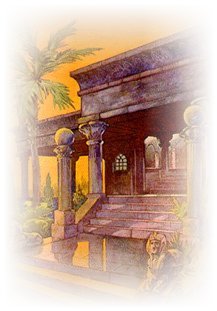 The legend has it that Hiram Abi 'initiated' Solomon into the 'secret knowledge' (the word) after 3
workers found a golden stone in the lower deeps of the foundation of the temple. This
stone had the name of the true God engraved on it. Of course that name was 'secret' and
was at the time only known by the men who discovered it besides King Hiram, Hiram Abiff, and Solomon.
The other men were Adoniram, Joabert, and Stolkin.
The legend has it that Hiram Abi 'initiated' Solomon into the 'secret knowledge' (the word) after 3
workers found a golden stone in the lower deeps of the foundation of the temple. This
stone had the name of the true God engraved on it. Of course that name was 'secret' and
was at the time only known by the men who discovered it besides King Hiram, Hiram Abiff, and Solomon.
The other men were Adoniram, Joabert, and Stolkin.
In Egyptian magic, even if the exercisers did not understand the
language from which the Name was borrowed, they considered it necessary to
retain it in its primitive form, as another word would not have the same virtue.
The author of the treatise on the Egyptian mysteries attributed to Jamblichus
maintains that the barbarous names taken from the dialects of Egypt and Assyria
have a mysterious and ineffable virtue on account of the great antiquity of these
languages. The use of such unintelligible words can be traced in Egypt to a very
great antiquity. Around the world, the Creator's name is spelled and pronounced
differently. Freemasonry is non-sectarian.
Today in the Masonic Ritual, this word is still lost so a substitute word was
formed to be used until the real one could be rediscovered. From The Hiram Key;
The words of Kamose reflect the invention of this substitute word after his father Sequenenre Tao
II was murdered in 1554 BC.
"The elders prepared new substituted 'secret words and rituals'.
Then Kamose stuck a finger in the air at Aphophis by changing his name to
'Wadj-kheper-re', meaning, 'Flourishing is the Manifestation of Re', meaning "you Failed".
Christopher Knight and Robert Lomas,The Hiram Key, page 141.
"The Second or 'Fellowcraft' Degree of Freemasonry gives very
little knowledge to the candidate but it does introduce the idea of 'hidden mysteries of nature
and science' and makes a clear reference to what is called the 'Galilean Heresy'."
- Christopher Knight & Robert Lomas, The Hiram Key: Pharaohs, Freemasons
and the Discovery of the Secret Scrolls of Jesus
York Rite Masonic Ritual: A. "That it was the book of the law in
which it was written, I am the Lord, I appeared unto Abraham, unto Isaac and Jacob by
the name of God Almighty, but by my great and sacred name was I not know unto them."
We find that Moses got the 'word' given to him by God himself. In the book of Jubilees (1:27
and 2:1), the angel who is said to have instructed Moses on Mount Sinai and to have delivered
to him the tables of the Law is most probably Michael. In scripture his name is,
"I AM THAT I AM". Masonic legend says Enoch is the King that engraved the 'word' on the stone and hid it.
After Enoch, as far as we know, Moses was the first man to know the Heavenly Father’s
or Elohim’s (God’s) name some 2,513 years after Adam and Eve were expelled from the Garden
of Eden. Before that time the Hebrews referred to the creator as El Shaddi or Almighty Provider (Exo. 6:3).
This proves that if anyone had written anything prior to Moses they would not have
used the true names, but El Shaddi. The creator’s name was revealed to Moses
in a vision by an angel appearing in a burning bush to him. Since we know that Moses was fully
instructed in Egyptian magic and wisdom, invoking God's name could produce miracles and
catastrophes on a massive scale...like the 10 plagues and even the eruption of the Santorini
volcano.
On Hiram Index 1, from the Book of Jasher we have a story about Moses and
"The magical Sapphire rod of Elohim." So the 'staff' of Aaron
was even more powerful than the bible admits. And this proves that magic was used by Elohim (God).
Most of the ancient texts are now available to anyone who takes the time and diligently searches.
The ancient texts contain material that most people have never even heard of - little lone read.
Stories about the deluge, Enoch, Noah, Moses, Cain and Abel, the Ark of the Covenant, Sodom and
Gomorrah, Abraham, Adam and Eve, and others are found in these texts, the only difference
being; the names of the patriarchs are in the language of the area in which they were found.
Scholars have translated most of the material and it's connection to the biblical stories cannot
be disputed. We also use the Nag Hammidi Scrolls, The Egyptian Book of the Dead, The Dead Sea
Scrolls, The Enuma Elish, The Torah in it's original form, and even the Koran. More secrets still
come from the Book of Jubilees and the Book of Jasher which were left out of the cannon by
the Roman compilers of the first bible, which wasn't put together until 425 AD.
 We have tried to include as much of this information as we could find to help our brothers
and anyone else interested in finding out what the church wanted kept secret or actually suppressed.
Apparently the Vatican went to great lengths to steal and hide texts that contradicted their teachings.
We have tried to include as much of this information as we could find to help our brothers
and anyone else interested in finding out what the church wanted kept secret or actually suppressed.
Apparently the Vatican went to great lengths to steal and hide texts that contradicted their teachings.
When we get to the Knights Templar Page we find a messenger and three other people were killed
when the messenger tried to smuggle a secret book called Le Serpent rouge from the castle at Rennes-le-Chateau
out of France to Germany.
The three people were Fakhar ul Islam, Louis Saint-Maxent and Piere Feugere.
All found dead between February 20 and March 7, 1967. The book in question contained poems.
But it also contained references to the Blanchefort family, to the decorations in the
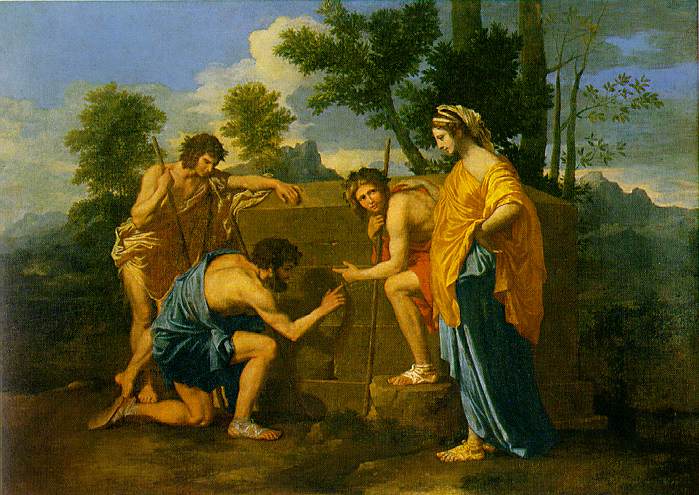
church at Rennes-le-Chateau, to some of Sauniere's inscriptions there, to Nicolas Poussin and the
painting of Les Bergers d'Arcadie, and to a motto on a tomb, "
Et in Arcadia Ego"

When we began our quest, we were already interested in Egyptian
culture and we had already read Graham Hancock's book Fingerprints of the Gods,
which left us wanting more information. So we read his The Sign and the Seal.
Then we read Message of the Sphinx co-authored by Robert Buval. After that everything
began to make sense. Masons of the 16th and 17th century had the same idea and they already
knew what we were about to find out. Egypt has everything to do with Masonic secrets, the
"Initiates" and the "Mystery Schools" of ancient societies.
The Masonic so-called secrets are not only complicated
and cover a wide range of subjects but also contain facts that are revealed in ancient texts
that were written up to 5000 years before any bible or Koran appeared on the scene.
Church fathers will say these stories are myth but with all the new information available to us,
we can now say they are actually history lessons.
Myth once replaced truth because the truth for the church is too
dangerous. The texts contain dates and places and the same people as verified by scripture only
they are written in cuneiform, hieroglyphs or the language of the country in which they were found..
As we know, there are two lines of descent mentioned in the KJ bible; One from Cain, One from Seth since Abel
never married. Each of these lines has Enoch as a son. From Enoch comes the arts and sciences which he was instructed
by God to pass on to mankind. But we don't see this in the Bible. Another text says, Eve only had one son with Adam and
that son was Seth. Did Cain really have a great great grandson named Enoch?
The following is from Temple Legend or "The Mystery Known to
Rosicrucians."... which again exposes another side of the story.
"There was a time when one of the Elohim (Gods - plural)
created a human being whom he called Eve. That Elohim united himself with Eve and she gave birth to Cain. After this,
another Elohim, named Yahveh, created Adam. The Elohm Yahveh also united himself with Eve and from this union came Abel."
Enki allowed Adam and Eve the ability to pro-create, thus Seth was conceived and became the first 'born of man' human.
Thus we see in this myth that Cain is a direct descendant of the gods, but Seth is a descendant of Adam and Eve who are
divinely created humans. Now the myth proceeds:
"The sacrifices which Abel made to Yahveh were pleasing to him, but the sacrifices brought by Cain did not
please him because the birth of Cain was not ordained by him. The result was that Cain committed fratricide. He
killed Abel and for this he was excluded from communion with Yahveh. He went away into distant lands and founded
his own race there." This race has no facial hair.
"Among the descentants of Cain are all those who have been creators of art and science, as, for instance,
Methuselah, the inventor of the Tau script, and Tubal-Cain, who taught the use and working of metal ores and iron.
In this line of descent, stemming from the Elohim, were all those who trained themselves in the arts and sciences."
Even Carl Sagan, the well-known and respected astronomer, knew that Cro-magnon man could not have evolved from
the Neanderthals without outside assistance in genetics. The change is way to dramatic and quick. Also, Cro-magnon man was
living at the same time as the Neanderthals. Egyptian, Indonesian, Chinese, South American and Native American cultures;
Each one was founded or damaged by the involvement with the Annunaki and have based their religions and myths on their
culture and activities. Some Annuna were favorable toward mankind, like Enki, while others were destroyers of cities, like Adad
(also known as Yahweh and Jehovah).
Ask any mason and they will tell you there are NO SECRETS ANYMORE because in the age
of the internet you can research any subject! We found that to be true.
A Word to the Wise
Those who become Freemasons only for the sake of finding out the secret of the order,
run a very great risk of growing old under the trowel without ever realizing their purpose. Yet
there is a secret, but it is so inviolable that it has never been confided or whispered to anyone.
Those who stop at the outward crust of things imagine that the secret consists in words, in signs,
or that the main point of it is to be found only in reaching the highest degree. This is a mistaken
view: the man who guesses the secret of Freemasonry, and to know it you must guess it,
reaches that point only through long attendance in the lodges, through deep thinking,
comparison, and deduction.
He would not trust that secret to his best friend in Freemasonry, because he is aware
that if his friend has not found it out, he could not make any use of it after it had been
whispered in his ear. No, he keeps his peace, and the secret remains a secret.
Properly speaking, what is transmitted by initiation is not the secret itself, since this is
incommunicable, but the spiritual influence that the rites vehicle and that makes possible
the interior work by means of which, with the symbols as base and support, each one
will attain that secret and penetrate it more or less completely, more or less profoundly,
according to the measure of his own possibilities of comprehension and realization.
The initiates secret is a method of spiritual improvement, which stems from a hard
inner work aimed to transform the initiate, that is to make him go beyond his present form
in order to achieve a new one: it refuses religious dogmas and pushes initiates toward a
perfection’s status, which, even if unattained, nevertheless will be considered a rule for their
actions.
Initiation, undertaken in the proper mindset, with a man properly prepared, both in
his mind and in his heart, will set a man on the first step of a spiritual awakening. This
spiritual awakening is different from the one proffered by religion, which is about the
rightful worship of the deity from the creature to his creator, while the initiates process is
about improving the inner man, that he might seek an awakening of the spirit, and thus
become a balanced creature, at once mortal and spiritual.
This spiritual awakening is, after all, what the initiates experience is all about. We are told
in the ritual, ask and it shall be given, seek and you will find, knock, and the door will be
opened to you. This is as plain and open as initiatory rites get for a man.
Yet, it is up to the man to seek. The degrees only prepare a man, open his eyes so he
can see the door. It is up to the candidate to walk the path. Since the secrets of freemasonry
cannot be communicated, the man must undertake the search and do the work. Nothing worth
having comes easily.
A further consequence is that such a secret cannot be betrayed, because profanes are outside
the initiatory world so void of any means – rites and symbols – to do any inner work.
Freemasonry is not a secret society, even if it has a “closed” character. This does not
hinge upon a reason of prudence – even if in the past times persecutions justified it – but
rather to avoid the danger of degeneration, by admitting profanes who are not fully qualified
to grasp the secret. These men will remain profanes with the apron, and sooner or later they
will “waste the chain”, because they are reluctant to walk the inner path.
From
Beacon of Masonic light Blog spot
Every person has not only the right, but also the
obligation to seek after and find the mysteries of heaven!
"The ultimate success of Masonry depends on the intelligence of her
disciples." - Albert Mackey
Masonic tradition: Our version
Since the dawning of time men have searched for immortality. Why, because
at one time the gods bestowed this as a gift on certain 'chosen' mortals. There are only three
in the Christian faith that we know of who were given this gift. But what we forget is, these men
were NOT Christians, Muslims or Jews, ect., in that time and place. There was Enoch, Noah and
Jesus. However the Christian 'faith' doesn't mention this proclaiming Jesus to be the only one admitted.
The raising of Hiram symbolizes how a man can be raised to a
perfection and understanding of one's self that is only available in this life. This comes from
an ancient Egyptian ritual wherein a dead king was raised to an area beyond the Earthbound
plane of consciousness and into a life of immortality. In fact Philip tells us in the Nag Hammidi scrolls;
"Those who say that the Lord died first and (then) rose up are in error,
for he rose up first and (then) died. If one does not first attain the resurrection, he will not die.
As God lives, he would [live...]. "Those who say they will die first and then rise are in error.
If they do not first receive the resurrection while they live, when they die they will receive
nothing.
So also when speaking about baptism they say, "Baptism is a great thing,
" because if people receive it they will live."
Therefore it is a spiritual awakening.
This has nothing to do with Jesus' 'physical' resurrection as some have been misled to believe.
see The Gospel of Philip
 Masons all believe in 'life after death', however some
of us just have a different way to approach the subject. It doesn't suggest any religion
nor does it support any one in particular. We do not worship any devil and our
'Pit of Serpents' page
explains where this false accusation originated. It is called The Taxil Hoax.
Masons all believe in 'life after death', however some
of us just have a different way to approach the subject. It doesn't suggest any religion
nor does it support any one in particular. We do not worship any devil and our
'Pit of Serpents' page
explains where this false accusation originated. It is called The Taxil Hoax.
We try to respect all religions, but we are not a religious entity. As in the time of Jesus,
our minority of 'the Gospel of Truth' is growing. Many people who are 'burnt out' with some
of the malicious lies of church leaders who teach people to 'hate' and condemn other beliefs
and the people connected to them, are seeing it our way. We invite you to join us.
"They have told us for wrong, that we are not gods.
Every being is part of god, because of this, spiritual things have no location and no time; god is
not an idea, it is a consciousness, not grasped by the mind."
If you can accept that the God we refer to as the true God is the God
of all people, then you will be able to find the answers to many questions here. Some of those questions
pertain to the contradictions we find in many religious writings.
That is what makes Masonry unique. Since Masonry is not a
religion, as individuals we can look in many places to seek answers. As individuals,
(And since this is a private non lodge connected site) we have
tried to show no prejudice against anyone for what they believe. Religious Tolerance is
the key to finding and understanding many hidden secrets.
So, to be blunt: The archaeological evidence does not agree
with KJ biblical text in several instances.
So you have to ask yourself; Are you willing to read religious history from a different viewpoint -
An archaeological viewpoint that is literally 'written in stone'? These are backed up by offsite
links connected to the text or the unbiased scholarly review of the finds.
"You can't have a light without a dark to stick it in." — Arlo Guthrie.
"And the light shineth in darkness; and the darkness comprehended it not." — John 1:5.
"We can easily forgive a child who is afraid of the dark; the real tragedy of life is
when men are afraid of the light." — Plato
More clues that there might be "Secrets".
Ancient Symbolism
On page 125 of The Secret Teachings of All Ages, Manly P. Hall writes:
"Frank C Higgins, a well-known Masonic symbolist, has astutely noted that the ornate
headgears of certain gods and Pharaohs are inclined backwards at the same angle as the
earth's axis."
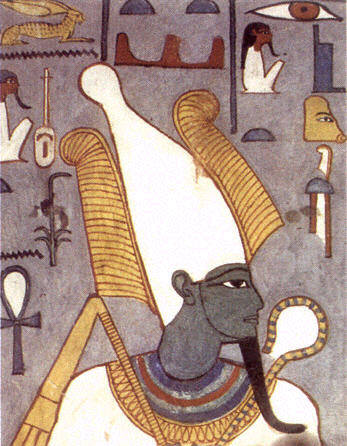 Indeed before Philip had sent me this quote, I had already noticed that depictions
of Osiris showed the Atef crown was angled at 23 to 23.5 degrees. There's more to this than
many of us know. Again, there are numerous references that indicate the ancients had
knowledge of the obliquity of the earth's Axis - even precession - and that this was made
important to them - and again, its something that has been largely overlooked.
Indeed before Philip had sent me this quote, I had already noticed that depictions
of Osiris showed the Atef crown was angled at 23 to 23.5 degrees. There's more to this than
many of us know. Again, there are numerous references that indicate the ancients had
knowledge of the obliquity of the earth's Axis - even precession - and that this was made
important to them - and again, its something that has been largely overlooked.
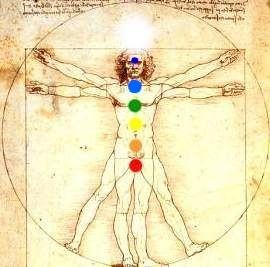 The ancient Egyptian god Osiris was not only associated with the eye (inner eye) as
his name Aus-ir implies, but in his depictions as the
Djed Column, he was also associated
with the human spinal column associated with the internal processes of the enlightenment
experience (Kundalini) which centre on the spine and the
seven chakras relating to the
seven endocrine glands. He was also known as the God of the Staircase - a staircase having
seven steps. The "seven steps" also refer to
The Seven Liberal Arts of Masonry.
The ancient Egyptian god Osiris was not only associated with the eye (inner eye) as
his name Aus-ir implies, but in his depictions as the
Djed Column, he was also associated
with the human spinal column associated with the internal processes of the enlightenment
experience (Kundalini) which centre on the spine and the
seven chakras relating to the
seven endocrine glands. He was also known as the God of the Staircase - a staircase having
seven steps. The "seven steps" also refer to
The Seven Liberal Arts of Masonry.
H.P.H. Bromwell (1823 -1903) wrote in his massive tome Restorations of Masonic Geometry
and Symbolry that: "Although the number of recognized sciences far exceeds seven, yet, giving
to that number the benefit of its symbolic meaning, it stands for the whole circle of sciences,
whether specifically named among the seven or not." The seven signs of the zodiac, from the
vernal equinox to the first point of Scorpio, 'winding' in a glittering curve about the heavens,
may in a like manner be said to be emblematic of seven winding steps. "In the most general
terms the Winding Staircase defines seven 'levels of consciousness', from consciousness of
the physical body at the bottom to consciousness of the Spirit and Divinity at the top.
The idea of chakras as understood in Eastern philosophy does not exist in Western medical
science. In Eastern thought, the chakras are thought to be levels of consciousness, and states
of the soul, and 'proving' the existence of chakras is akin to 'proving' the existence of a soul.
A mystic deals with these metaphysical concepts on the metaphysical plane, as a model for
their own internal experience, and when talking about 'energy centres', they are generally
talking about subtle, spiritual forces, which work on the psyche and spirit, not about physical
electrical or magnetic fields.
Among the many titles ascribed to Osiris, one frequently used is the god of the
staircase. In Chapter XXII of the Ritual the deceased prays that he may have a portion
with him who is on the top of the staircase, and there are any number of illustrations of
a stairway of seven steps.
As the authors of Hamlets Mill (1969) have demonstrated, myths were indeed used to
transmit complex truths and its possible that to preserve knowledge, an intelligent and
scientifically-advanced people had decided to intervene in the cultures of people around the
world; shaping their cultures and loading certain information which would be absorbed
in their art, their clothing, their rituals and their folk tales.
In other words, they depended on uneducated people to accurately and directly
transmit the information across millennia and to the scientists of the future. What they
didn't reckon on was that a great deal of this information i.e., the more mystical knowledge
would be subject to discrimination; in that what wasn't understood would be misinterpreted
and become corrupted, and what would be understood, would either be ignored, kept secret,
covered-up by mundane explanations and suppressed.
Those who have heard various theologians speak on different passages of the bible,
or who have read books on theology, perhaps better understand the complexity that might
exist in a religion that lasted for well over 3,000 years, but which has no live theologists
that might explain its mysteries.
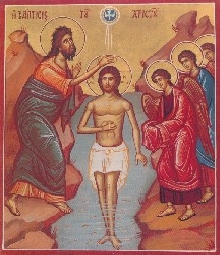 Another example: This Byzantine painting shows Jesus being anointed by God at the
same time he is being baptized by John.
Another example: This Byzantine painting shows Jesus being anointed by God at the
same time he is being baptized by John.
Both anointment and baptism are metaphors to the same experience of enlightenment.
Note the three attendants on the right. Are these the three Magi as referenced
by the three pyramids of Gaza?
The head of Jesus is between two mountain peaks - the open legs of the world
mother. His feet (two fishes) are swimming in the astral womb waters of the
flowing river. The Dove disk is the star Sirius the Underworld and world mother
from which he has been reborn.
The river in which the reborn shaman god-king is being baptized. His baptism also
symbolizing his rebirth as regards his initiation into the mysteries is possibly the River
Nile, which flows east of, and right next to the three pyramids. Again, if true, then the
disk containing the dove is the star Sirius in the south sky, associated with the
world mother Isis. Again this baptism is associated with the thalamus and the glands
in the brain. The Triad also represented by the three angels or three wise kings.
see Book of Thoth
and see Masonic articles
from ..The Bank of Wisdom Presents the Origin of Freemasonry (Reprint of 1919 Pamphlet)
Plato, 400 B. C., "said that the object was to reestablish the soul in its primitive purity; the
Roman philosopher, 500 years later, Epictetus, to uphold the "instruction of man and the
correction of morals."
Aristotle said the Mysteries were the most valuable of all religious institutions; Socrates,
that they brought to the dying the most glorious hopes for eternity.
The Mysteries were practiced in Rome until 400 A.D.; in Athens, until 700 A.D.; in Wales
and Scotland, until 1100 A.D. They contained conceptions that have deeply affected the religious
history of the world. In Greece they were given in four stages:
Preliminary purification;
Communication of mystic knowledge;
Revelation of holy things;
Crowning of the mystic as a privileged person.
A flash of Insight, by which one sees the connections between things.
The ultimate capture, and if one can sustain it, is experienced as enlightenment. As said, this
experience can awaken and alter and change, quite drastically, the pattern of ones life, ones
perceptions and beliefs.
Tell-Tale words
The word "US" appears in Genesis 3:22, 1:26
and Genesis 11:7. "Let US go down".... US? Who is "US?"
We also find the word "OUR" as in 'our likeness', 'our image' in Genesis.
Have you seen this and ignored it? Did you think it was a typo? Think again!
Look at the book of Daniel (4:13,17,23 an older copy) and see the word "Watcher"
(messenger). Enoch also speaks about the "Watchers" in his secret books which were also left
out of the bible. The answers to the many questions raised by these words were also found in
the 5000 year old Enuma Elish or Sumerian Tablets, in the book of Jasher and the book of Jubilees.
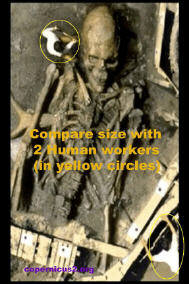 More clues to the rebel god (Watcher) story are found in
Psalms 82:1, "God presides in the great assembly; he gives judgment among the "gods". (plural)
More clues to the rebel god (Watcher) story are found in
Psalms 82:1, "God presides in the great assembly; he gives judgment among the "gods". (plural)
82;6, "I said, 'You are "gods"; you are all sons of the Most High.'
"But you will die like mere men; you will fall like every other ruler."
All 200 of them!
These are the gods of Genesis 6:2 and in 6:4 we find the
sons of the gods called the 'Nephilim'. The fallen angels are called
'Watchers' in the book of Daniel and Enoch's Books. The 'Nephilim' are
'the giants' that roamed the earth in the time of Noah. They are not really 'fallen angels', but
giant rebel half-man, half-gods!
Genesis 6: "For owing to these three things came the flood upon the earth, namely, owing
to the fornication wherein the Watchers against the law of their ordinances went a whoring after
the daughters of men, and took themselves wives of all which they chose." As we can see this is
another version of Genesis 6 which lends evidence that there were many versions of the same story
throughout history and time. It also supports the theory that there are two gods.
see
God takes over the 'rulership'
of the world. see footnotes Psalm 82. It plainly says "Israel's god". (Meaning Jacob's god.)
('Israel' means 'deceiver!')
"AND HE SAID UNTO HIM, WHAT IS THY NAME? AND HE SAID, JACOB." Jacob confessed
his name, which means "supplanter" or "deceiver." We may say, he admitted he was a sinner.
Jacob’s name was changed from "deceiver" to "Israel," which means, "God rules; or strives with
God; or a prince of God; or overcomes and prevails; or God’s fighter." (again, which god?)
God - Judge of the earth: according to Deut 32:8-9, Israel's God had originally assigned
jurisdiction over the foreign nations to the subordinate deities, keeping Israel as a personal
possession. Now this God did directly take over the rulership of the whole world.
Did the church hide the archaeological evidence of the "Watchers" and the offspring 'giants' from
mankind? We found the proof and it is displayed on
Hiram Index 5,
but there is much, much more to the story before the "Watchers".
There is also overwhelming evidence that Nimrod was not an evil man
and as we shall see, was not against the true God. He was against a god that wanted men as
slaves and nothing more.
Every person has within his or her reach, the knowledge of God if
they will but seek, knock, open and obey, if their heads are not like Hemlock knots if they will
" not fly to pieces like glass as soon as anything comes that is contrary to their traditions."
Quoted from The Best Kept Secrets of the Gospel of Jesus Christ by Lawrence D.
Gardner
We are not all scientists but at the same time we do not listen to
dogmas that restrict our natural curiosity or our search for knowledge. On this web site,
we are using the King James Bible and other books, scrolls and tablets to look for
more facts that support the story but go into much more detail - like, where did Cain and Abel's
wives come from? And who was the Pharaoh of the Exodus?
Details about the
Nephilim.
If we are to understand why one god wanted to destroy mankind, and why
there are many different religions, maybe we should investigate this material more thoroughly.
Man's knowledge began with building skills and the art of metallurgy. Metallurgy was Nimrod's skill,
while Tubal-Cain "made all kinds of tools out of iron and bronze" and Jubal made musical instruments.
The early church used Nimrod to condemn science and force man into the 'dark ages'. However
the Books of Enoch indicate God wanted men to know the skills and He instructed Enoch to pass
them on to his sons so that only righteous men would know them. This is the origin of 'the
Craft'....This is how Masonry began.
With this in mind, we wondered how the
God of the Jews and the God of Abraham who is also important in Islam, could also be the Christian's
or Buddhist’s God too. Under the 'FEAR and OBEY' tags he is indeed the Jews, Muslims and the Christians god.
That means there is indeed a secret that Jesus wished to be revealed to mankind in an
Age of Reason and Understanding that wasn't present in the 30's AD..
This is the Age of REASON, Understanding and Logic.
What we discovered makes perfect sense and it distinguishes the difference between
the TWO GODS we found in Genesis.
Be advised that this web site is not like any other Masonic web site on
the net. We present Esoteric knowledge. Esoteric knowledge is that which is specialized or
advanced in nature, available only to a narrow circle of "enlightened", "initiated", or highly
educated people. The term esoteric first appeared in English in the 1701 History of Philosophy
by Thomas Stanley, in his description of the "Auditors of Pythagoras." The Pythagoreans
were divided into "exoteric," which were under review, and "esoteric," which had
performed well enough to be admitted into the "inner" circle. The
Essenes studied
Pythagoras. The Essenes have everything to do with Jesus.
A variety of past traditions could be classified as forms of "esotericism" due to
their similar "inner" focus as well as their "selective" and "secretive" nature.
Please keep in mind that most of the esoteric information we present here is not found
in lodge work, except for the curious words found in the 'focus' of the degrees. But why the
words are there in the first place leaves many unanswered questions. We present the 'Focus'
of the Degrees on a separate page. The publishing of these degrees was first committed
to being open to the public in 1955 at the Library of the University of Delaware, permitted
by the Supreme Council, 33' ( Northern Masonic Jurisdiction, USA ) These are from a Manual
for Officers of Subordinate Bodies of the A.A.S.R.F.
This site is written in story form and may be easier to follow if
viewed in that manner. For those unfamiliar with the tradition we present,
we offer our 'Forbidden knowledge' pages. These lay the background for the
rest of the work. We encourage reading the 'Forbidden' pages and
the first three of the 'Passage forward' pages before going on to
other pages. You will not gain an understanding of the real Hiram
until you read the "Light" page which follows Passage page 3. And there
are three 'hidden pages'. For this reason there is no 'next' or 'previous'
and no side bar navigation menu to these pages.
Our other reason for not including all the page links here is; A Mason must ASK to be admitted to the
Lodge, he must ASK to be admitted to the higher degrees. So you also must ask for further light by continuing with the many
pages in this site. There is a Site Map and other links after the first two introduction
pages of each series which include; the Hiram Forward series, the Hiram Intro series, forbidden 1
and 2, The Widows Son 1 and 2, and Passage Forward 1 and 2. The oldest pages in the site are
the Passage pages and material presented there by not be available to research now,
as quoted from a web page or a referenced book that may be out of print.